Wings of Self-Sufficiency
The Czech Republic has a long and rich aviation history that reaches back to the early days of flight and predates the independence of former Czechoslovakia from Austria-Hungary in 1918.
The newly emergent nation had a ready and able talent pool of highly skilled professionals from a variety of technical disciplines and hit the ground running from the moment it was established as a free and sovereign state. This should come as no surprise as Czech and Slovak technical prowess was a driving force behind much of the Austro-Hungarian Empire’s industrial and military might.
The Škoda Works of Plzeň, for example, was founded in 1859 and was the largest arms manufacturer in Austria-Hungary at the outbreak of the First World War. Another example was the Vítkovice iron and steel mill established in Ostrava in 1828. Vítkovice was the most important iron and steel producing facility in Austria-Hungary as well as being a major producer of armaments for the empire until the end of the First World War.
As Czechoslovakia was a fully landlocked nation, it should also come as no surprize that developing a domestic aviation industry was an early priority. Letov was founded in 1918 and was the first Czechoslovak aviation company.
Initially founded as Air Arsenal, a state run repair and servicing facility for the foreign aircraft that made up the Czechoslovak army’s aviation arm, Air Arsenal quickly came into its own as a designer and manufacturer of aircraft. Air Arsenal was renamed to Main Aviation Workshops before the Letov name was finally put on it in the mid 1920s.
Letov was a strong performer in the interwar period with a prolific output of aircraft designs in both civilian and military categories.
As with all companies in the former Czechoslovakia in the Second World War, Letov was forced to support the German War effort. The company was used as a repair facility for Geman military aircraft and a production facility for the Junkers Ju 290 aircraft.
The last aircraft fully designed and built by Letov was the LF-107 Luňák glider which first flew in 1948. After the Communist takeover of the Czechoslovak government in 1948, Letov was tasked strictly with producing components for aircraft made by other manufacturers.
Letov still exists today and has been a subsidiary of French based Groupe Latecoere since 2000. Currently, Letov makes components and structures for civilian aircraft from Airbus, Boeing, Dassault and Embraer.
Letov can lay claim to the first domestically designed and mass produced Czech military aircraft, The Letov Š-1. The Š-1 first flew in 1920 and was followed soon after by the updated Š-2 version.
Nearly 100 examples of this aircraft family were built and stood as testament that the new nation was capable of supplying its military with a competent, homegrown aircraft to defend its skies.
Let’s spend some time with the Letov Š-1 and Š-2:
Getting off the Ground
The Letov Š-1 did not have an easy start, and could easily have never existed at all if sceptics in the Czechoslovak military had their way.
In the formative years of the Czechoslovak military air arm, there was a great deal of debate regarding the ability of domestic aircraft companies to supply aircraft to the military that were competitive with foreign designs.
The military favoured foreign suppliers, particularly France. The French government and French aircraft companies were quite eager for the opportunity to supply aircraft to the Czechoslovak military. In fact, a number of French aircraft types served in the nation’s military in the interwar period; examples included the SPAD VII and XIII fighters along with a fleet of Bloch MB.200 bombers that were license built in Czechoslovakia by the Aero and Avia companies.
In the face of military scepticism, the various domestic aircraft producers rose to the challenge and began designing aircraft that would serve military interests.
There was a lot of national pride on the line. The Czechs and Slovaks had just come out from under centuries of Habsburg rule and were eager to show the world that they were capable and competent of being a self-sufficient and modern nation in every aspect, including national defense.
Design work began on what would become the Š-1 in 1919, with the prototype taking to the air for the first time in April of 1920. The aircraft was intended to fill the light bomber and reconnaissance roles. Shortly after the first flight, the military ordered five aircraft for trial purposes.
In autumn of 1920, a more refined prototype was exhibited to an international audience in Prague. This served notice to the world at large that the aviation industry of Czechoslovakia was a competent one and not to be overlooked as a potential supplier of aircraft.
Soon after that exhibition, the Czechoslovak military placed an order for 50 of the new aircraft.
Not Perfect, but a Start
The new aircraft, initially designated as Šm-1, was an ambitious design for the time.
While it was a biplane, as was still common for the timeframe, the Šm-1 was constructed completely from wood. This contrasted with many of its contemporaries that still incorporated large areas of cloth covering on wood frame in their construction.
The fuselage of the aircraft was perhaps the most notable aspect of the design as it was made from molded plywood construction. It was a construction method most famously associated with the World War Two era DeHavilland Mosquito from Great Britain, but was very unusual in the immediate post World War One period.
While the molded plywood construction method gave the Šm-1 a strong fuselage that was more durable than traditional cloth on frame construction, it made the aircraft unpopular with ground crews and maintenance personnel. Repairing damage to the wooden fuselage was more complex and took longer than with the cloth on frame types the crews were more familiar with.
Pilots were also not fond of the aircraft as it had issues with directional stability, so was a challenge to fly. Despite several attempts by Letov to remedy the stability problems, they were never overcome.
In spite of the above problems, the Šm-1 and its descendants succeeded in showing that the Czechoslovak aircraft industry was up to the task of providing aircraft to the nation’s military that were of a modern standard.
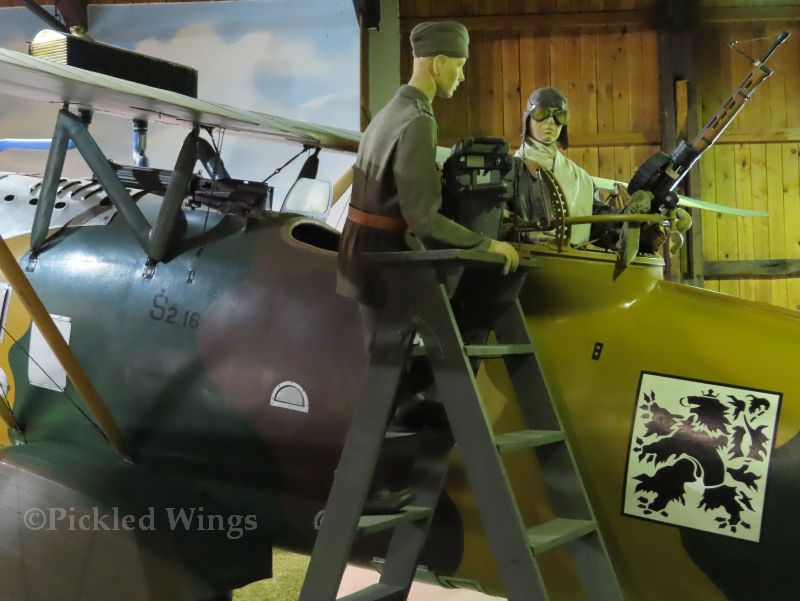
Only the engines and armaments of the aircraft were of foreign origin. Early variants were fitted with a six cylinder Hiero engine of Austrian design, while later variants used a six cylinder Maybach engine of German origins. Both early and later versions featured a British designed Vickers machine gun for the pilot and a ring mount for a pair of American designed Lewis guns for the observer.
In the light bomber role, the aircraft could carry two 50 kilogram bombs or twelve 10 kilogram bombs. It could also be fitted with a camera for reconnaissance work.
The Šm-1 and its descendants formed a small family of aircraft comprised of two main variants, the engine fit being the main point of differentiation:
Šm-1/Š-1
The Šm-1 and Š-1 are the same aircraft. The difference came from a change in the Czechoslovak military designation system, where the Š-1 designation replaced Šm-1 in 1923.
These early versions of the aircraft were fitted with a six cylinder Hiero L engine of around 230 horsepower. A total of 28 examples of the Š-1 version were made.
Š-2
The Š-2 designation was used for later aircraft that were fitted with a six cylinder Maybach Mb.IVa engine of around 260 horsepower. The change of engines was due to the Hiero L engine being out of production and in very short supply. By comparison, the Maybach engine was plentiful and easy to accquire.
The Maybach engine brough a modest improvement in the aircraft’s performance, but came with its own set of drawbacks. The main issue was that the Maybach Mb.IVa was optimised for use on airships rather than conventional aircraft. To make it work on conventional aircraft, the engine needed a number of adjustments made that added further challenge to flying the aircraft, such as very sensitive throttle and carburetor controls.
A total of 64 examples of the Š-2 version built; fellow Czechoslovak aircraft company, Aero, license built 40 of them.

The Mind Behind the Machine
Alois Šmolík (1893-1952) was the man behind the design of the Letov Š-1. An aeronautical engineer and business man, Šmolík was the chief designer and technical director of Letov from its establishment until he left the company 1943.
Šmolík’s interest in aviation showed while he was still a student at technical school. He build his first glider in 1910 and his first powered aircraft in 1913.
He joined the military in 1913 and was wounded in late 1914 while serving on the Russian Front. After being wounded, he was reassigned to Vienna and tasked with organizing the design department of the Austro-Hungarian air force. He also spent some time building his knowledge of aeronautics through study at the Vienna Institute of Technology.
Šmolík returned home to Prague after the war and helped to establish the state run Aviation Arsenal, which would eventually be renamed Letov.
Under Šmolík’s watch, the company flourished and produced a remarkable number of aircraft types, some of them seeing significant production runs for the time period.
Aside of the Š-1 and Š-2, important Letov designs from the interwar period included:
- Š-4: First flown in 1922, the Š-4 replaced French made SPAD VII and XIII fighters in Czechoslovak service. 20 were made.
- Š-6: A bomber first flown in 1923, the Š-6 set a new altitude record for flying with a 500kg payload. It also set a national record for endurance flight at 10 hours and 32 minutes. 35 were made.
- Š-16: First flown in 1926, this bomber design existed in several variants and was exported to Latvia, Turkey, and Yugoslavia. 89 were produced.
- Š-18: First flown in 1925, the Š-18 was a training aircraft that was exported for military use to Bulgaria and Finland. The aircraft proved quite popular with private pilots and flying clubs as well. 46 were built.
- Š-20: A fighter design first flown in 1925, it was used mostly by the Czechsolovak military with a small number exported to Lithuania. Approximately 118 were built.
- Š-31: First flown in 1929, the Š-31 and its derivatives were fighters. Aside of Czechoslovakia, versions of this aircraft were used by the Slovak air force during the Second World War. They were also used by the Republican forces during the Spanish Civil War and the Spanish air force after the civil war. 33 were produced.
- Š-39: A sport aircraft first flown in 1931, it was popular in flying clubs in Czechoslovakia. 21 were built.
- Š-328: First flown in 1933 the Š-328 was a reconnaissance aircraft used by air arms in Bulgaria, Estonia, Germany, Romania as well as Czechoslovakia. It was used by both the Slovak air force and Slovak insurgent forces during the Second World War. Approximately 412 were made.
Alois Šmolík left Letov in 1943. As German occupation forbade any design and construction of Letov’s own aircraft in favour of the company servicing German needs, there was nothing to keep Šmolík there. He moved his family to Příbram, south-west of Prague, and spent the rest of his life in non-aviation related work there.

What Remains and Learning More
The interwar period was a time of remarkably quick advances in aeronautics. For aircraft from a newly established nation in that timeframe, the Letov Š-1 and Š-2 did well for themselves.
In spite of their shortcomings, nearly 100 were built and they served the Czechoslovak military from 1920 to 1926 before being gradually replaced by more modern domestic designs, such as the Aero A.12 and A.11.
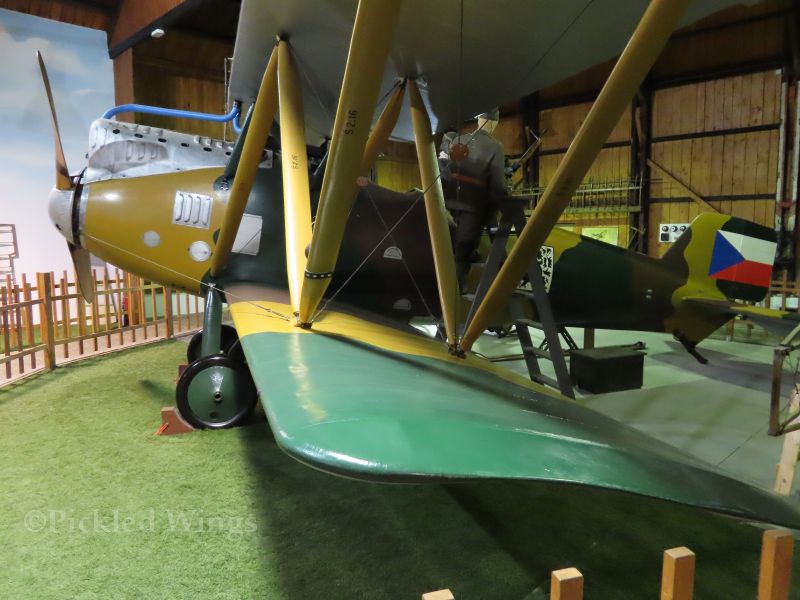
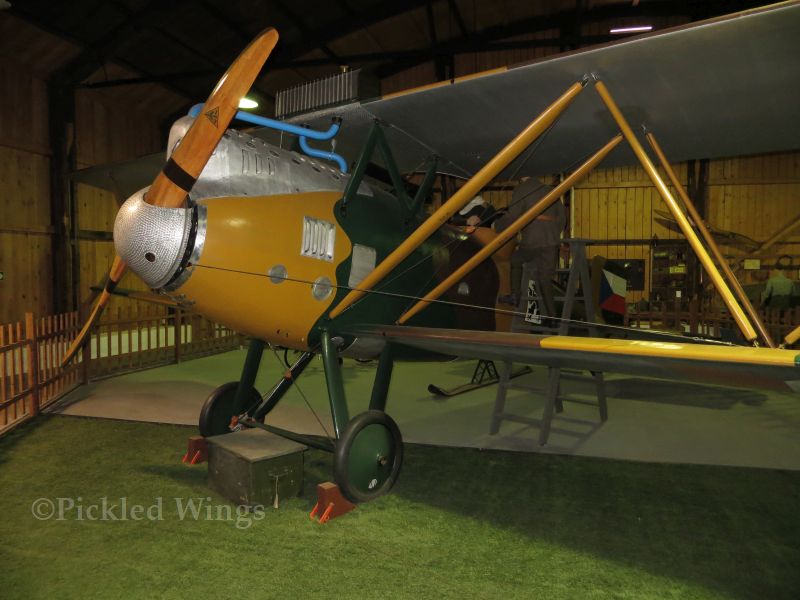
Only one example of this aircraft family remains intact to the present, an Š-2 that is part of the excellent Kbely Aviation Museum collection in Prague, Czech Republic.
This specific aircraft was removed from service in 1926 and ordered to be scrapped in 1928. Happily, the aircraft was spared and taken into the collection of the Military Museum of the Czechoslovak Republic.
The aircraft was moved to the National Technical Museum’s care in 1935 and remained in their collection until it was transfered to the Kbely museum in 1979.
A large scale restoration of the aircraft began in 1983 and concluded in 2003.
Further Reading
To learn more about the Letov Š-1 and Š-2, a good start would be to visit the dedicated articles about the types on the Československé Letectví and vinar.cz websites. Both articles are written in Czech, but respond reasonably well to online translator functions.
You can also visit this page at the Czech Military historic Institute’s website. It contains general information about the Š-1 and Š-2 as well as more detailed information about the Š-2 preserved at the Kbely Aviation Museum. This article is also in Czech, but works well with online translator functions.

 Pickled Wings
I had never heard of this type before. It has the feel of the WWI German Albatross D III fighter series in looks and construction, which also used a molded wood fuselage construction. Interesting that it utilized Allied machine guns rather than Imperial German or Austro-Hungarian weapons. Too bad it was forced to use unsuitable airship engines. Thanks for the Czech industrial history lesson as well.
I know what you mean, though it reminds me a bit more of the Roland C.II bomber than the Albatros D series fighters. With the Czech history of arms making, I’m surprized they didn’t have domestically made guns already to hand that were suitable for arming it. As for the engines, I suppose that depends on what the domestic engine manufacturers had on their production lines at the time.
Yes, I’d forgotten the odd Roland Whale reccon/bomber 2-seater. Rugged and all purpose but not loved because of handling and visibility issues. Hand drawn lace curtains on the fuselage windows! Those strange Germans, the whole thing rather outlandish.