
From Obscurity to Front Runner
The term “MiG” became, through the course of the Cold War, a near synonym for fighter jets originating from behind the Iron Curtain. “MiG” itself is the standard prefix used to identify aircraft designed and built by the Mikoyan-Gurevich bureau of the former Soviet Union and is still used today by its descendant company, Mikoyan.
While the Mikoyan-Gurevich bureau was established in 1939, its contribution to the Second World War was relatively minor. The only MiG aircraft to serve in the conflict was the MiG-3; a high altitude fighter that turned out to be of limited use in the lower altitude nature of Eastern Front air combat. The MiG-3 was quite fast in a straight line but lacked maneuverability; consequently, it found itself primarily tasked with reconnaissance work.
This situation meant that MiG spent the war in the shadow of the Lavochkin and Yakovlev bureaus who produced the bulk of Soviet fighter aircraft in the conflict. On the surface, this seemed a very negative thing for the young bureau; however, it did give them a window of opportunity to experiment with more revolutionary aircraft and propulsion designs that Lavochkin and Yakovlev did not possess. This put MiG in very good stead to take a leading role in jet aircraft development in the immediate post war period.
Through actions in the Korean War, which lasted from 1950 to 1953, the MiG-15 elevated the Mikoyan-Gurevich bureau from a bit player in the Second World War to a leader in the jet age, a position from which the bureau would never look back.
Mikoyan-Gurevich were not the only Soviet producer of fighter jets, but they became the best known and the MiG-15 was the beginning of a long and legendary line of jet fighters to bear the “MiG” prefix.

The Jet Race at Home and Abroad
In the immediate post war years, jet propulsion in fighter aircraft was being worked on by aircraft manufacturers around the world with varying degrees of success until practical and serviceable jet fighter designs were developed.
Among the first post war jet fighters to enter military service were the Lockheed F-80 Shooting Star and Republic F-84 Thunderjet from America, the DeHavilland Vampire and Gloster Meteor from Great Britain and the Yakovlev 15/17/23 series and the MiG-9 from the Soviet Union. Though jet powered, none of the designs were particularly pioneering. They all had straight wings and showed a degree of World War Two era thinking in many other aspects.
In the Soviet Union, the Mikoyan-Gurevich and Lavochkin bureaus were both working on more modern jet fighter aircraft prototypes that would eventually lead to the MiG-15 and the Lavochkin La-15. The Mikoyan-Gurevich prototype would take to the air for the first time in late 1947 while the Lavochkin prototype flew for the first time in early 1948.
1949 saw the MiG-15 and La-15 enter Soviet service while the Americans introduced the F-86 Sabre in the same year. In 1950, Sweden’s Saab J-29 fighter entered service. All four aircraft featured swept wings in their designs and performed much better than any of the straight winged jets before them.
The La-15 was, from a technical point of view, somewhat superior to the MiG-15. However, it was also a more complex design and more expensive to produce and maintain. In the end, though both planes were popular with pilots, the La-15 was destined for a short service life with favour being given to the MiG-15’s simplicity of construction and servicing.
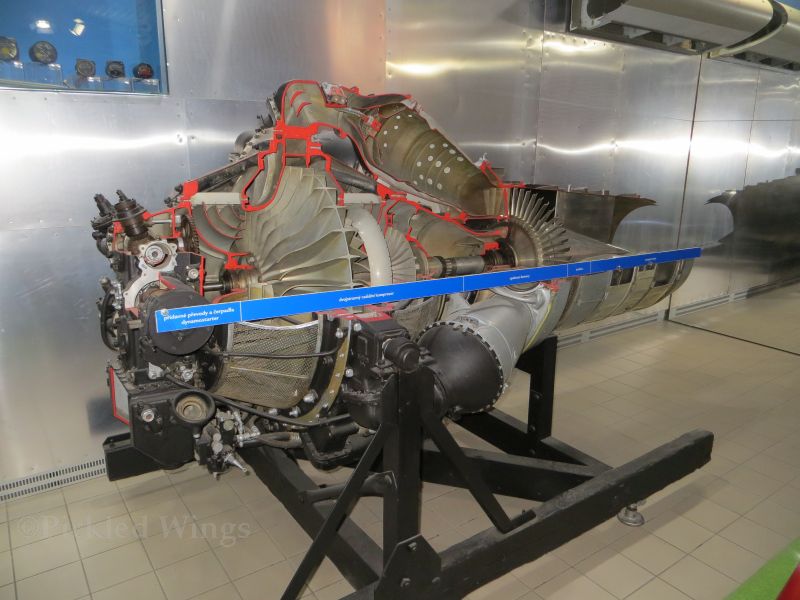
Early versions of th MiG-15 were powered by a Klimov RD-45 engine, which was a copy of the British Rolls-Royce Nene engine. Later versions were powered by the Klimov VK-1, an improved version of the RD-45.

Popular and Plentiful
The MiG-15 very quickly became popular with pilots for its good handling qualities along with a very comfortable working environment in the cockpit thanks in large part to an excellent air conditioning and heating system.
The aircraft’s undemanding maintenance regime also made it popular with ground crews. This was important as the bulk of those ground crews were made up of conscripts with minimal training.
The straightforward design and construction of the MiG-15 also made it easy to produce in other countries under the Soviet sphere of influence at the time. Over 18,000 MiG-15s were produced between assembly lines in the Soviet Union, Czechoslovakia, Poland and China. This gives the MiG-15 the distinction of being the most produced jet fighter in history.
In its military life, the MiG-15 served in the air arms of over 40 nations. It was known to be in military use until the 1990s.
The qualities that made the MiG-15 popular in its military life have also given it a popularity in the Warbird community and many of the type are mantained and flown by civilian operators in various places around the world.

Order of Battle
As with many of its contemporaries, the MiG-15 was on its way to being replaced by more advanced fighter types by the end of the 1950s. While it did see some combat after the 1950s, it was in that decade that it played its most important roles in combat.
Chinese Civil War
The MiG-15 got its first taste of combat during the closing stages of the Chinese Civil War in early 1950.
The Communist government of mainland China requested assistance from the Soviet Union in turning back bombers of the Republic of China (Taiwan) that had been attacking targets on the mainland.
The first unit of Soviet MiG-15s arrived in China in February of 1950 and started air patrols as well as the training of Chinese crews on the jet.
The airspace over commonly targeted areas on the mainland was well protected and, after losing some aircraft to the MiGs, Republican Chinese bombing raids had stopped by April of 1950.
Korean War
The dogfights between the MiG-15 and the Sabre in the Korean War are well documented and the two aircraft generally were considered very closely matched.
While the MiG could climb higher than the Sabre, outmaneuver the American aircraft at higher altitudes and had more powerful guns; many of the Sabre pilots were experienced combat pilots who had flown in World War Two.
Against Chinese or North Korean MiG pilots, the combat experience of the Sabre pilots was very often the deciding factor in the outcome of a battle. On the other hand, battles against Soviet pilots who were secretly flying in the conflict and frequently had combat experience could end quite differently in spite of the Sabre pilots’ skills.
Taiwan Strait Crisis
Not long after the Korean War ended, MiG-15s and Sabres were fighting each other again. This time, the fight was the Taiwan Strait Crisis that lasted for most of the 1950s and saw Chinese MiG-15s going against Taiwanese air force Sabres over the Taiwan Strait that divides Taiwan from mainland China.

The Big Prize
Over the course of the Cold War, the MiG-15 was used in a number of pilot defections from Eastern Bloc nations to the west. The most significant of these defections was connected with Operation Moolah.
Initiated in Spring of 1953, Operation Moolah offered a large cash sum and American citizenship to any MiG-15 pilot willing to defect with one. To this end, American bombers were used to drop millions of leaflets near North Korean air bases to inform potential defectors of the reward that awaited them.
The plan paid off when a North Korean pilot defected with a fully armed and operable MiG-15 in September of 1953, two months after the armistice that ended the Korean War.
Operation Moolah gave the Western Bloc their first close look at a fully intact and operational MiG-15 along with the opportunity to extensively examine and flight test it.
The pilot of the aircraft, No Kum-Sok (1932-2022), claimed to know nothing about Operation Moolah or the reward associated with it. He became a naturalized American citizen and Anglicized his name to Kenneth H Rowe. He spent many years as an aeronautical engineer for several American companies and as a professor of the subject at Embry-Riddle Aeronautical University.
The aircraft he used in his defection is preserved in the National Museum of the United States Air Force in Dayton, Ohio.

The MiG-15 Today
Given that the MiG-15 holds the record as the most produced jet fighter in history, it should come as no surprize that it has done very well for itself in its post-military life.
Several examples of the type are preserved in museums around the world, so your chances of getting up close to one in that context are quite good.
Beyond museums, there are also several examples of the type kept airworthy on civil air registers around the world and regularly flown at airshows and for experience rides. As such, depending on your location, you might see a MiG-15 performing at an airshow near you. Depending on your finances, you might also be able to purchase an experience ride in a MiG-15.
Learning More
This link will take you to a Czech language article about the MiG-15 in Czechoslovak military service. It responds generally well to online translators.
Some of the MiG-15s that remain airworthy have their own pages on the internet. These links will take you to pages about MiG-15s actively flying in The Czech Republic, Norway, and the USA.
 Pickled Wings
I am sincerely glad to have found this site. I’ll be here quite often.
I’m glad you’re enjoying it.
Aerodynamically the MiG15 became dangerously unstable near mach and pilots needed to avoid that region. OTOH the F-86 Sabre easily went sonic in a slight dive. As proved by test pilot George Welch’s F-86 sonic booms as he became the first pilot to exceed the speed of sound weeks before the other, more famous, military pilot exceeded mach 1 in level flight in the X-1 rocket experimental test plane. Great post, MiG 15s and Sabre jets were my favorite planes as a kid.