A Lasting Mark and Enduring Image
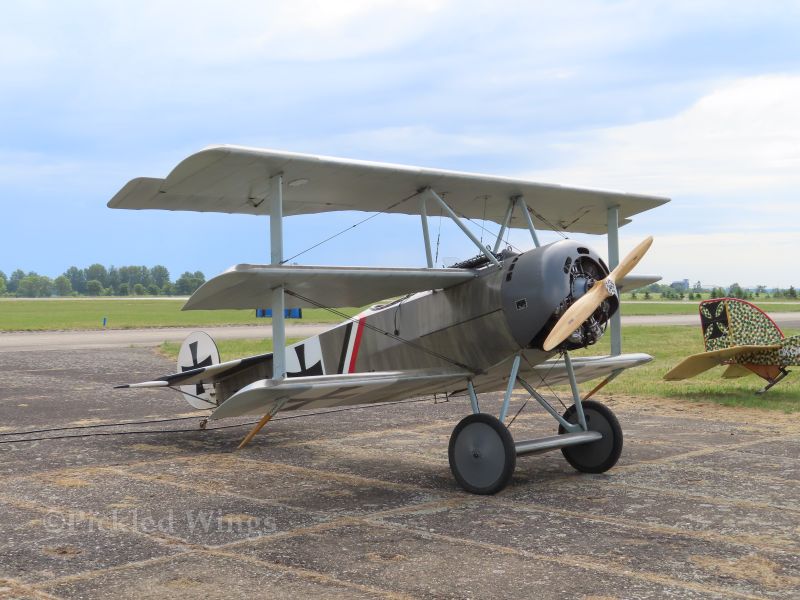
Fokker, the Dutch aircraft company founded by Anthony Fokker (1890–1939), produced numerous military and civilian aircraft during its 84-year history. However, few aircraft built by the Dutch firm between its establishment in 1912 and its closure through bankruptcy in 1996 became more closely associated with the Fokker name in popular culture than the Dr.I Dreidecker—the storied Fokker Triplane used by Germany during the First World War.
Developed under the direction of Reinhold Platz (1886–1966) and first flown in July 1917, the Dr.I became not only an icon of the Fokker company but also of German air power in the skies over the Western Front.
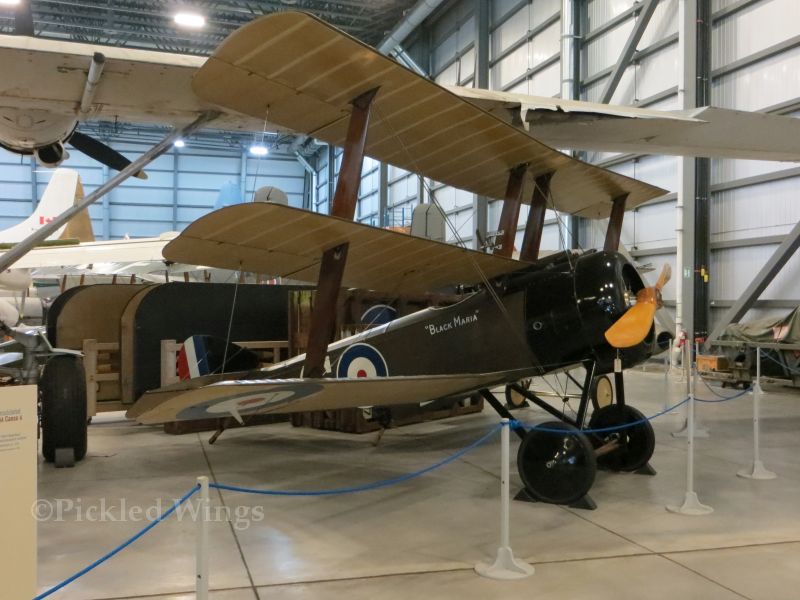
Over the years, the legend of the Dr.I has grown so much that it has, to some extent, overshadowed the Sopwith Triplane that inspired it. Nicknamed the “Tripehound,” the Sopwith aircraft was used to great effect by the Royal Naval Air Service against German fighters during the early months of 1917. Its success inspired a brief wave of triplane development among German and Austro-Hungarian aircraft manufacturers. Of the competing German designs, only the Fokker Dr.I achieved sustained operational success.
For all the accolades given to the Dr.I, however, it was far from a perfect aircraft. Equally important is the fact that many of the men who flew it were already highly regarded ace pilots before the aircraft was conceived, a point often understated in accounts of the Dreidecker‘s history.
With that in mind, it is worth examining both the virtues—and the vices—of this legendary machine.
Comparisons with the Sopwith Triplane
The Dr.I shared more than just its triplane configuration with its Sopwith predecessor. Both aircraft derived their greatest combat advantages from their exceptional climbing ability and remarkably tight turning performance, qualities that made them popular with the pilots who flew them.
Both the Fokker and Sopwith triplanes were built in relatively small numbers—320 and 147 respectively—and both had short service lives. The first Sopwith Triplane squadron became fully operational in December 1916, but by December 1917 the aircraft had largely been relegated to training duties. Similarly, the Fokker Dr.I entered service in late August 1917 and was withdrawn from front-line duties between June and July 1918.
Superior biplane designs soon superseded both triplanes. In British service, the Sopwith Camel began replacing the Triplane in June 1917. The Dreidecker‘s successor was another Fokker product, the D.VII, which had entered widespread service by the early summer of 1918. Notably, despite the Dr.I’s legendary reputation, it was the D.VII that became the only aircraft specifically named in the Armistice terms ending the First World War, with all surviving examples ordered surrendered to the Allies.
Both triplanes experienced structural and maintenance issues during service, although these proved considerably more serious in the case of the Dr.I. The Sopwith’s design made routine servicing unnecessarily difficult, often requiring extensive disassembly for relatively modest maintenance tasks. In the Dr.I’s case, the rotary engine presented a significant logistical challenge. Castor oil, the preferred lubricant for rotary engines, was in short supply in Germany, and no satisfactory substitute could be developed. By late 1917, German fighter production increasingly favoured liquid-cooled inline engines, making rotary-engine replacements and spare parts progressively more difficult to obtain.
Structurally, both triplanes were susceptible to failures of their upper wings during steep dives. Much has been written over the years about the Dr.I’s wing failures, often attributing them solely to poor workmanship and inferior materials. While manufacturing shortcomings certainly contributed to the problem and Fokker implemented improvements that addressed many of the concerns, later aerodynamic studies also demonstrated that the Dreidecker‘s upper wing was frequently subjected to greater aerodynamic loads than the centre wing—sometimes more than twice as great. Together, these factors help explain the partial or complete upper-wing failures experienced by some Dr.I aircraft
Evolution of the Dreidecker
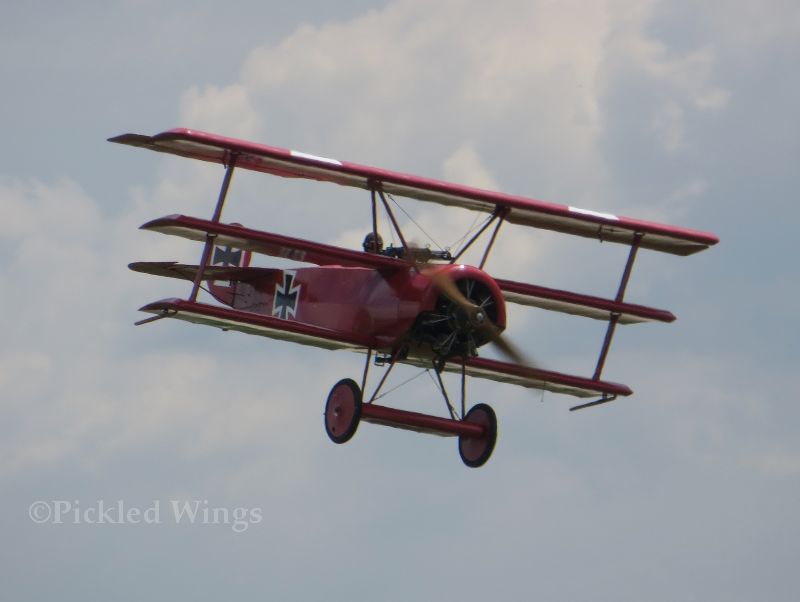
With only 320 built and a front-line career of approximately one year, it is no surprise that the Fokker Dreidecker family had only one major operational variant: the Dr.I. Nevertheless, the earlier development aircraft are worth examining to better understand how the design evolved.
V.4
The V.4 was the initial prototype. It began as a biplane, but Anthony Fokker ordered it reconfigured as a triplane after visiting the front lines, where several German fighter pilots told him how impressed they were by the Sopwith Triplane. Only one V.4 was built.
V.5
The V.5 was the refined prototype developed from testing of the V.4. It incorporated several improvements, including balanced ailerons and elevators that improved handling, along with interplane struts that reduced the vibration experienced by the V.4’s upper wing during flight.
F.I
The F.I designation was assigned to a small pre-production batch developed from the V.5.
Three F.I aircraft were ordered by the military—one for static testing and two for combat evaluation. Although all three were eventually destroyed, the two sent to the front acquitted themselves well before they were lost.
Dr.I
Entering production as the Dr.I, the aircraft differed only slightly from the F.I. The most visible change was the addition of wooden skids beneath the lower wingtips to protect the wings during rough landings. Other refinements included revisions to the engine cowling and horizontal stabilizer, along with larger ailerons.
The Men Who Made the Machine
While the aircraft itself evolved only modestly, its enduring reputation would ultimately be shaped by the men who flew it.
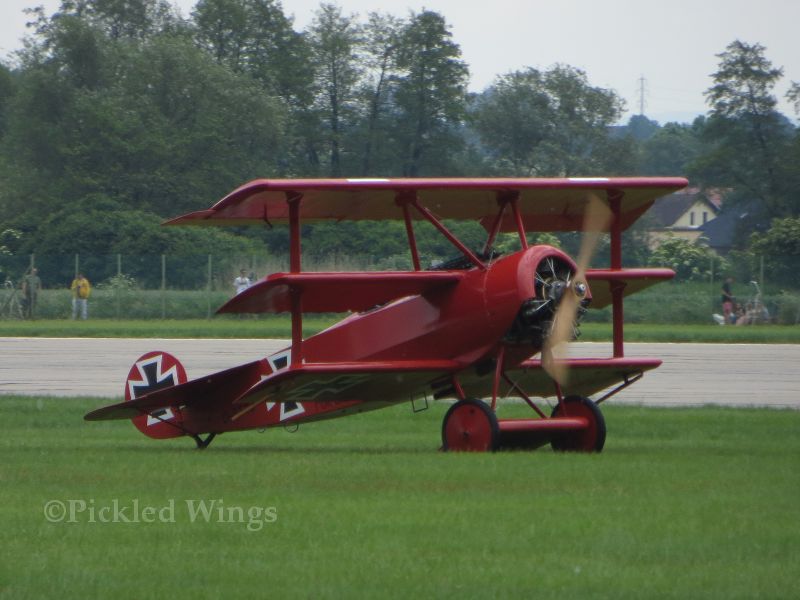
The pilot most closely associated with the Dr.I was Manfred von Richthofen, the Red Baron, who scored 19 of his 80 aerial victories while flying the aircraft.
For the Dr.I’s legend, however, Richthofen’s influence as a commander proved every bit as important as his skill as a fighter pilot. As commanding officer of Jagdgeschwader 1 (JG 1), he was given considerable latitude in selecting experienced fighter pilots to serve in the formation’s four component squadrons. The men he selected were already established aces. Werner Voss, Ernst Udet, Wilhelm Reinhard, Hans Weiss, Kurt Wolff, and Lothar von Richthofen all served within this elite formation.
The Dr.I’s reputation was also enhanced by experienced pilots serving outside JG 1. Among them were Paul Bäumer, Johannes “Hans” Werner, Hans Pippart, and Rudolf Klimke, all accomplished aces whose names became closely associated with the aircraft in combat.
By most accounts, the Dr.I was not an aircraft suited to inexperienced pilots, and reports of novice aviators flying the type in combat were relatively uncommon. By late 1917, Germany was no longer assigning inexperienced pilots directly to elite fighter units equipped with Dr.Is.
Viewed in context, it is fair to say that the Dr.I owes more to the men who flew it than they owed to the aircraft. Even Manfred von Richthofen acknowledged that, despite its excellent handling, the Dr.I lacked the speed needed to pursue faster Allied aircraft effectively.
Like many legends, the Dreidecker‘s story has its larger-than-life aspects. Although the Dr.I became one of history’s most recognizable fighter aircraft, it served at the front for less than a year and equipped only a small proportion of Germany’s fighter squadrons.
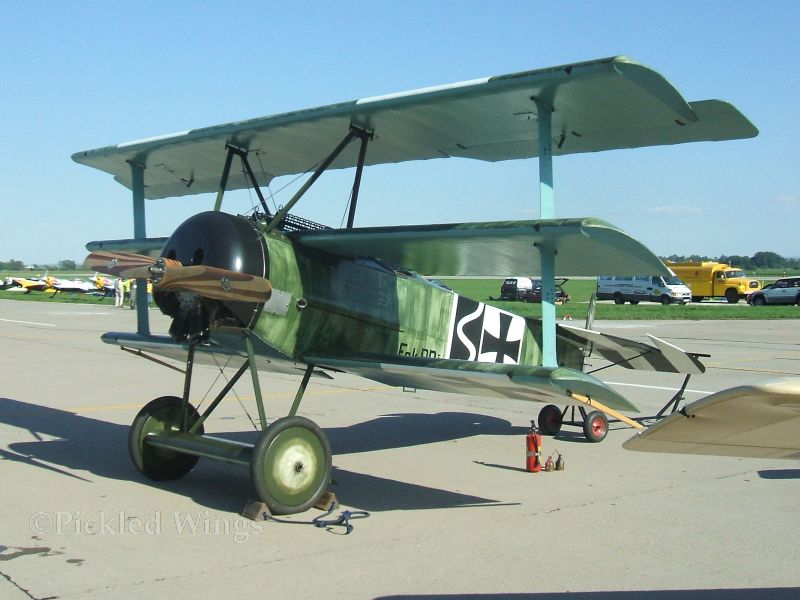
The Fokker Triplane Today
As of 2026, no complete original Dreideckers are known to survive, although numerous artefacts remain.
Fortunately, replicas of the Dr.I—both airworthy and static—are common at air shows and in museums around the world. Most flying replicas are powered by radial engines, which successfully replicate the appearance, though not the operating characteristics, of the original rotary engines. Although no complete original Dr.I survives, the aircraft’s distinctive silhouette remains a familiar sight at museums and air shows around the world, ensuring that one of aviation history’s most iconic fighters continues to capture the public imagination.
Learning More
These links will take you to two articles about the Dr.I at The Aviationist website:
In print media, Fokker Dr I Aces of World War 1 is a highly respected book on the subject from Osprey Publishing.

