
Born in Depression, Bound for Greatness
Walter and Olive Ann Beech established the Beechcraft company in Wichita, Kansas in 1932. Prior to this, Walter Beech had been a co-founder of the Travel Air company along with other general aviation pioneers, Clyde Cessna and Lloyd Stearman.
Beech’s first product after forming his own company was the Model 17 Staggerwing of 1932, a very streamlined biplane designed for corporate aviation that proved faster than many military fighter aircraft of the day. It was a highly successful design for its time and remains popular with vintage aircraft operators today.
In the late 1930s, riding on the success of the Model 17, Beech set about designing a light, twin-engine transport and utility aircraft. In 1937, that aircraft took to the air for the first time as the Model 18. Though not a revolutionary or adventurous design, the Model 18 was a very clean, attractive, and well-thought-out machine, with small airlines and corporate operators as target customers. While the aircraft was intended primarily for the civil market, Beech had designed it with potential military use in mind as well.
The Model 18 was something of a gamble for Beech, conceived and designed on the premise that a market would exist for a smaller twin-engine aircraft. Happily, it was a bet that paid off in spades for Beech and for the many customers the Model 18 secured over the years.
The Model 18 enjoyed a production run of over 30 years that saw more than 9,000 examples built in over 60 factory-standard versions and at least 15 licensed modified versions by other companies.
Civil variants of the Model 18 revolutionized corporate and short-haul aviation in a way similar to how the immortal Douglas DC-3 transformed commercial aviation during the same period. Military variants were used to train countless Allied air gunners, bombardiers, and navigators during the Second World War.
At that, let’s spend some time with this most legendary of Beechcraft machines:
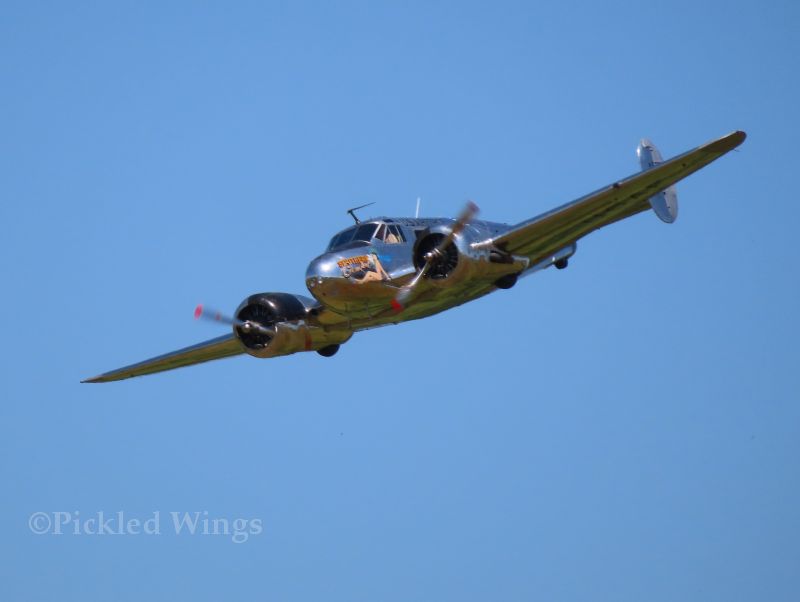
A Slow Start to Stardom
As renowned as the Model 18 would become, it may be difficult to believe that it experienced only modest success in the beginning.
Part of what gave the aircraft a slow start was direct competition in the American market from the somewhat larger, though similar-looking, Lockheed Model 12 Electra Junior. The Lockheed aircraft was slightly older and better established on the American market than the Model 18 and was a direct descendant of the proven Lockheed Model 10 Electra.
Neither the Model 18 nor the Electra Junior met with much interest from American commercial operators. In the pre-World War Two period, commercial air travel was still the exclusive territory of the wealthy traveler. The concept we take for granted today—of smaller aircraft flying feeder routes to connect with larger aircraft flying trunk routes from hub airports—was still very much in its infancy.
For the American corporate aircraft market of the late 1930s, the Electra Junior was stiff competition for the Model 18 and easily outsold the Beech product. However, the Model 18 was garnering steady orders from foreign customers in various sectors, which went a long way toward offsetting the imbalance against the Electra Junior in the domestic corporate market. Notable among these early foreign customers were several Canadian bush pilots. The Model 18’s rugged design, along with the ability to be fitted with float or ski landing gear, made it highly suitable for Canada’s frozen northern reaches and regions where water was the only available surface for operations.
The domestic fortunes of the Model 18 changed, albeit tragically, with the Japanese attack on Pearl Harbor in December of 1941. With America officially on a war footing, Lockheed was forced to focus its energies on its larger Model 14 Super Electra and Model 18 Lodestar.
With the Electra Junior out of the way, the door was open for the Model 18 to shine, and Allied militaries quickly became very interested in the type as both a trainer and utility aircraft. The Model 18 would excel in these roles and many others throughout WWII.

Into the Fray
The Model 18 had already seen modest military interest before the Pearl Harbor attack. By 1939, the U.S. Army Air Forces had a small fleet under the designation C-45 for personnel transport, as well as the F-2 variant for photographic reconnaissance. In the same year, Beechcraft reached an agreement to provide a small fleet of bomber trainers to the Nationalist Chinese government under the designation Model 18R.
Over 90% of American air gunners, bombardiers, and navigators received their training through specialized Model 18 variants. For USAAF navigators, there was the AT-7 Navigator, which had room for three students to learn the techniques for both celestial and radio navigation. Conversely, air gunners and bombardiers trained in the AT-11 Kansan, which was modified with a glass nose, dorsal gun turret, and a small bomb bay. In U.S. Navy service, the AT-11 and AT-7 had counterparts in the SNB-1 and SNB-2, respectively.
Ultimately, every branch of the U.S. military used variants of the Model 18. Such was the aircraft’s versatility that it quickly expanded beyond its initial roles, taking on other tasks such as air ambulance, communications, drone control, liaison, and VIP transport.
The Model 18 was referred to as the Expeditor II in Royal Air Force and Royal Navy service, and the Expeditor III in Royal Canadian Air Force service.
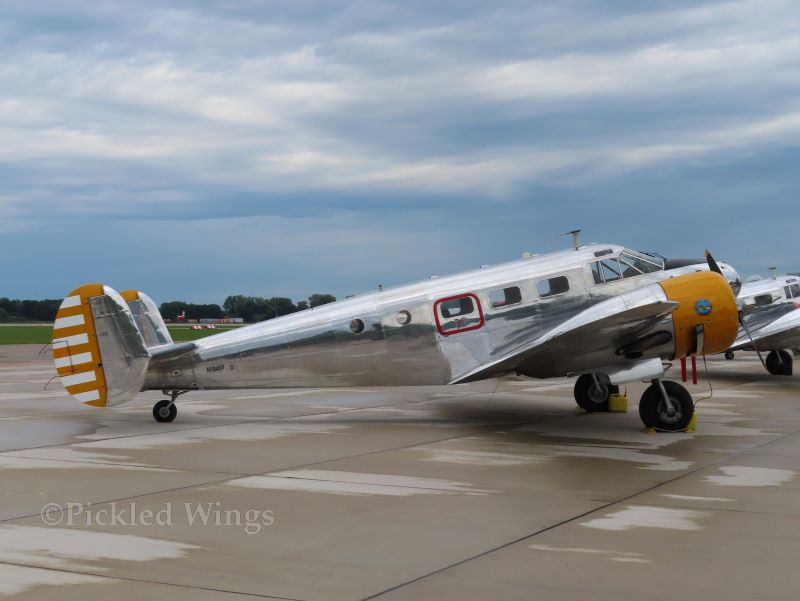
Almost Everything to Almost Everyone
While the Model 18 had a long military career beyond the Second World War, it also found extensive use in civilian life. Many were released onto the civil market immediately after the war. Being affordable as surplus and easy to support thanks to continued production, the aircraft showed as much—or even more—versatility in postwar civilian hands as it had in military service.
The Model 18 returned to its civil roots with ease. In the 1950s boom economy, the Beech 18s were still in demand by bush flyers in Canada as well as corporate users in other places. From the 1950s through into the 1970s, the Beech 18 formed the backbone of numerous small air freight companies throughout America. Additionally, the airline industry was opening to a wider range of customer classes and the Model 18 found a place in regional and feeder routes. Other civilian duties carried out by the Model 18 have included: agricultural work, aerial firefighting, police work, smuggling, sightseeing flights, skydiving platform, research flights and air ambulance among many, many others.
During the Vietnam conflict, extensive use of the Model 18 was made by the Air America organization. Much of this work was of a clandestine nature for the CIA.
The aircraft also found its way into cinema as both an aerial filming platform and a performer. The Model 18 has appeared in over 100 films and television series over the years.
The aircraft’s flexibility goes beyond job adaptability; in its long life, many modifications have been approved for the original design. Modifications have been introduced to increase the number of passengers it can carry, other modifications have seen the original piston engines replaced with more modern turboprop types and the tail wheel replaced with a more contemporary nose wheel landing gear arrangement. Over 200 adjustments, both subtle and obvious, have been approved as options for the original design.
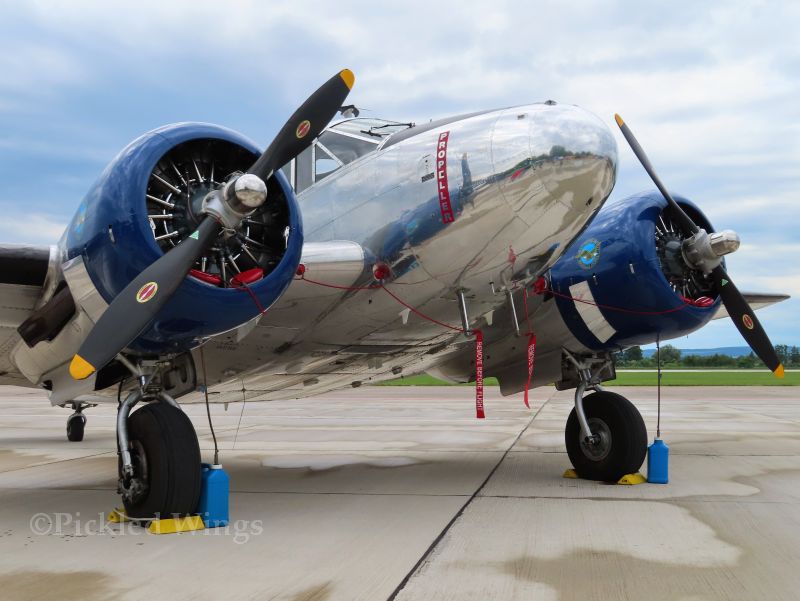
A Sentence and a Reprieve
The 1970s brought an uncertain future for many Model 18 aircraft due to structural flaws, corrosion and cracking in the wing spars. A wing spar reinforcement procedure was instituted to keep the aircraft legally flyable, but many owners decided to abandon their Beech 18s as they didn’t see the wing strengthening as a worthwhile expenditure on an aging aircraft. This left many Model 18s languishing and awaiting their fate in scrapyards.
Not all of the aircraft that went to scrapyards stayed there. The 1970s saw the beginning of a revived interest in vintage aircraft and their restoration; Beech 18s were plentiful and cheap to acquire from scrappers. That the Model 18 was still in active service and the production line had only closed in 1970 meant that spare parts and servicing for the aircraft were also readily available for those who wished to restore an example of this type to flyable condition.
Happily, many people who wished for a vintage aircraft to restore and fly have recognised and appreciated the Model 18’s historical significance. Thanks to such people, we are able to enjoy the sight and sound of this legend in the present day.
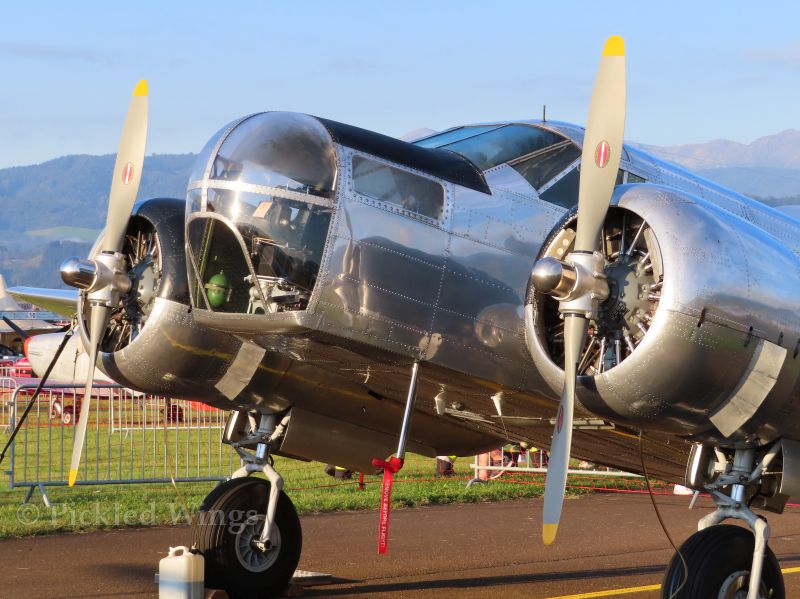
Still Going Strong
If you’ve ever been to an airshow that featured vintage aircraft in the performing line up then chances are good that you’ve seen a Beech 18 as many are flying on airshow circuits around the world. To see this surprisingly acrobatic twin engine aircraft put on a performance and then finish it off with a full power, low pass in front of the crowd is a treat to behold.
The good news is, if you haven’t yet witnessed such a spectacle, there’s still time. The Model 18 has an avid fan base among pilots, and several specialist companies exist to ensure ongoing service and spare parts for the aircraft. The Model 18 shows no signs of slowing down with age.
As of 2025, hundreds of Beech 18 family members remain airworthy worldwide. Many more are under restoration, preserved in museum collections, or stored as spare-parts donors. Chances are, you won’t have to travel far to see one in most parts of the world.
Further Reading
- Vintage Aircraft—This is the website of a group in California, USA, that specializes in the Beech 18 among other vintage aircraft types. The website has a wealth of information and photos of the Beech 18.
- Life’s a Beech—This is a 2007 article from General Aviation magazine that gives some good insights into what the Beech 18 is like to fly.
- I’ll Take the 18—This book is a very absorbing read about flying the Beech 18 as a freighter. It’s written by Scott H. Gloodt, a pilot with many hours on the Beech 18.
- Beechcraft CT-128 Expeditor—This article gives a good overview of the Beech 18 in Canadian military service.
- Beech 18 variants—The Beech 18 family tree is large and complex, this article gives a very good overview of it.
 Pickled Wings
It reminded me of something I wrote about.
August 1941 at No. 14 S.F.T.S. Alymer – http://wp.me/p1RdXZ-Mt
Some nice period pictures in that piece, thanks for sharing it. 🙂
Sharing is what it’s all about.