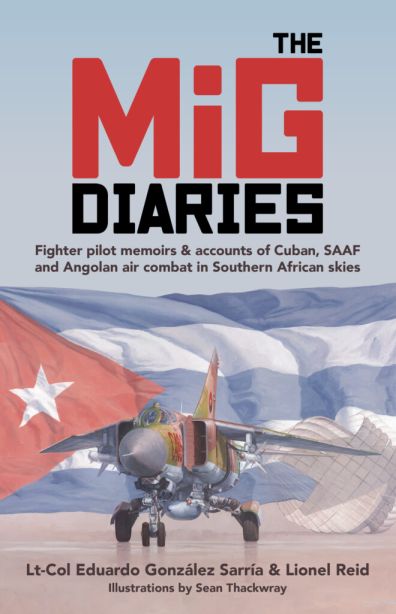
The MiG Diaries
By: Eduardo González Sarría and Lionel Reid
Illustrations by: Sean Thackwray
Burnet Media (2023)
Bringing Chaos into Focus
I discovered The MiG Diaries while researching the Mikoyan-Gurevich MiG-23 “Flogger,” an aircraft that is notoriously difficult to find balanced information about. After sifting through countless websites repeating the familiar line “The Worst Soviet Fighter of the Cold War,” I came across a review of this book and decided to give it a try. I am very glad I did.
The book not only offers the MiG-23 a fair hearing from pilots who actually flew it, but also provides rare clarity on the air war aspect of one of the major conflicts associated with African decolonization: the South African Border War (1966–1990).
As with many conflicts linked to decolonization, the South African Border War went by several names and overlapped with other struggles. Because the war centred on South Africa’s effort to retain control over South West Africa—now Namibia—it is also referred to as the Namibian War of Independence, depending on perspective. The conflict is further complicated by its temporal and geographic overlap with the Angolan War of Independence (1961–1974) and the Angolan Civil War (1975–2002), leading some to call it the Angolan Bush War.
The main focus of The MiG Diaries is the air component of the Cuban military intervention in Angola in support of the Communist side during the civil war. Cuban forces were present in Angola from 1975 to 1991.
Putting the Pieces Together
The impetus behind The MiG Diaries was to create a single volume in which the collective memories of veterans from all sides could be brought together to form an accurate, holistic account of the air war. In this, the book succeeds admirably.
Eduardo González Sarría, the primary author, reached out to South African Air Force veterans years after the conflict ended in order to document their experiences. Fortunately, many chose to share their recollections. The book also incorporates voices beyond Cuba and South Africa, including Russians involved in the Soviet advisory mission as well as some Angolan perspectives.
This multi-sided approach highlights the complexity of the region during that period—from both military and socio-political standpoints. It is a subject that could not be properly understood without contributions from all who lived it.
From the Air
As mentioned earlier, the book goes a long way toward placing the MiG-23 in proper operational context. A key point emphasized is that the air-to-air variants of the MiG-23 were designed primarily as interceptors. They were built to scramble quickly, patrol airspace with the aid of powerful radar, and engage targets with a mix of short- and long-range missiles. They were never intended for tight, turning dogfights.
The book features accounts of Cuban MiG-23s engaging South African Air Force Dassault Mirage F.1s. Drawing from pilots of both aircraft types, the authors demonstrate that the MiG-23 and Mirage F.1 were, in many respects, evenly matched—and that in skilled hands, the MiG-23 was a far more formidable opponent than its Western reputation suggests.
Mirage pilots were often surprised by the MiG-23’s rapid acceleration and sheer speed; MiGs could frequently accelerate out of weapons range before the Mirage pilots achieved a missile lock. Another surprise for the Mirage pilots was the MiG-23’s ability to attack from the front using radar-guided missiles, countering the assumption that it carried only heat-seeking weapons and would therefore have to attack from behind.
The book also discusses the tactics South African Mirage pilots developed to more effectively counter the MiG-23s.
Beyond these engagements, the book details missions in which MiG-23s and MiG-21s flew protective cover for Mil Mi-17 helicopters. The Mi-17 was an essential workhorse but highly vulnerable to ground-based anti-aircraft fire. Many helicopters and their crews were lost, and the authors give these stories the attention they deserve.
A Healing Journey
Like many war memoirs, The MiG Diaries recounts the daily challenges faced by combatants and the sorrow of losing squadronmates. Yet it also carries a strong current of reconciliation. Many former adversaries later became friends, including several South African veterans with whom the author corresponded while assembling the book. These post-war relationships add a noteworthy dimension to the narrative.
About the Authors
Eduardo González Sarría is a retired Cuban Air Force fighter pilot who served three tours in Angola and commanded a MiG-23 squadron during the conflict.
Lionel Reid is a retired South African Air Force pilot who flew light reconnaissance aircraft during the war and later transitioned to helicopters. His primary contribution to the book was compiling recollections from South African veterans.
Sean Thackwray, a former South African Air Force fighter pilot, is also a talented artist. His evocative pencil illustrations appear throughout the book, and he provided the cover art as well.
Conclusion
The MiG Diaries is a book I can recommend without hesitation to anyone interested in conflicts connected to African decolonization or war memoirs more generally. In addition to its accessible and highly informative text, the book includes three sections of photographs—many drawn from private collections and previously unpublished.
A link to the publisher’s page for The MiG Diaries can be found here.
 Pickled Wings