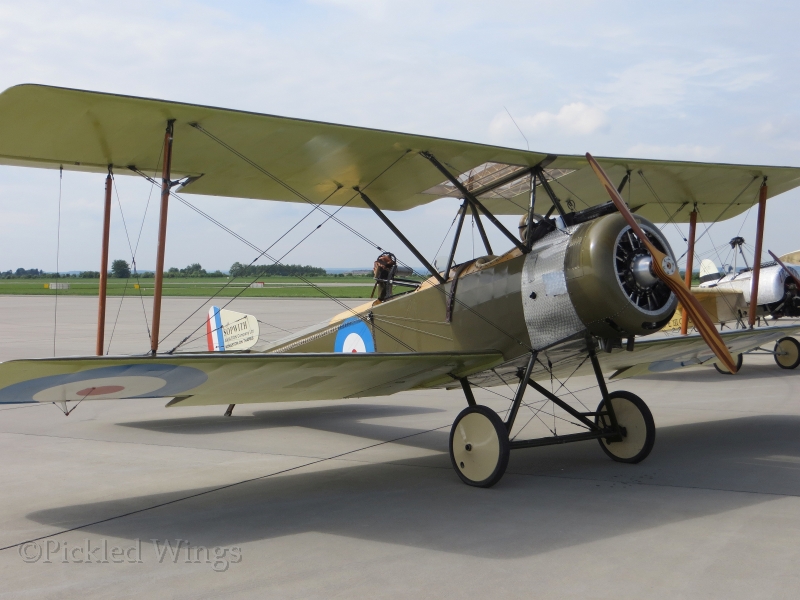
Establishing a Strong Pedigree
Few aircraft manufacturers are as synonymous with British fighters of the First World War as the Sopwith Aviation Company. Established by the young English aviation pioneer Thomas Sopwith in 1912, the company provided Britain and its allies with a series of modern and capable fighters throughout much of the conflict. While the company bearing Sopwith’s name was liquidated in 1920, this was far from the end of Sopwith’s involvement in aviation. That same year, Sopwith, together with test pilot Harry Hawker and two other men, co-founded H.G. Hawker Engineering. The company was renamed Hawker Aircraft in 1933 and went on to produce some of Britain’s most famous aircraft types until its dissolution in 1963.
Sopwith was a young company run by young men, most still in their twenties. As such, their designs tended to be more experimental and innovative than those of
many contemporaries. Beyond Sopwith himself, the nucleus of the company comprised the Australian-born test pilot Harry Hawker and engineer Fred Sigrist. Slightly later, Herbert Smith joined the firm as a designer.
The origins of the 1½ Strutter can be traced to a 1914 design by Fred Sigrist for a small, two-seat biplane, which first flew in the summer of 1915. Nicknamed “Sigrist’s Bus,” the sole example built was used as a company transport.
The design was later enlarged and fitted with a more powerful Clerget engine. Christened the LCT, short for Land Clerget Tractor, the prototype first flew in December 1915. Following testing, the aircraft was accepted into the Royal Naval Air Service (RNAS) in April 1916, and into the Royal Flying Corps (RFC) in July of the same year.

An Immediate Improvement
Until the introduction of the new Sopwith fighter, British combat aircraft were typically built with rear-mounted engines in a pusher configuration. While this arrangement gave the pilot and observer an unobstructed forward view, it left the aircraft highly vulnerable to attack from behind, as the observer could not easily defend the rear from his nose-mounted gun position.
Unofficially nicknamed the 1½ Strutter by the military, the new aircraft was the first British-built fighter to feature a tractor-configuration engine and synchronizing gear for the pilot’s forward-firing gun. The observer was seated behind the pilot and could more easily defend the aircraft’s rear quarters with a ring-mounted machine gun.
Beyond the advantages of the tractor engine layout and improved armament, the aircraft was a very advanced machine for its time. Although largely of conventional construction, the 1½ Strutter was a clean and efficient design, proving reliable and possessing the range and endurance to undertake missions deep behind enemy lines.
Despite these strengths, the aircraft had limitations. It was highly stable but lacked the agility to dominate in dogfights. It was also lightly built—a hallmark of Sopwith aircraft—which limited the manoeuvres that could be performed safely, such as steep dives.
These shortcomings prevented the 1½ Strutter from enjoying a long career as a front-line fighter. However, its stability and range gave it enduring value as a bomber and reconnaissance platform until the end of hostilities and beyond.
Perhaps its most significant contribution to aviation history was raising the profile of the Sopwith name and placing the young company in good standing with the British military as a trusted supplier. The 1½ Strutter marked the beginning of Sopwith’s prestigious line of fighter aircraft.

From the Somme to the Steppe
The 1½ Strutter’s first major combat came during the Battle of the Somme, which lasted from July to November 1916. At the outset of the battle, the RFC had only a single squadron of the type, composed of aircraft transferred from the RNAS.
For much of the offensive, RFC crews reported that the aircraft was both effective and popular. The 1½ Strutter had the range and endurance to penetrate deep behind German lines and sufficient armament to fight its way back.
As with many First World War combat aircraft, the 1½ Strutter was eclipsed in a relatively short time. By the time the second RFC squadron equipped with the type was formed in autumn 1916, the Albatros D-series fighters had begun reaching German squadrons and thoroughly outclassed the Sopwith.
While the Somme offensive was ultimately considered a loss for Germany, the arrival of the Albatros D-series towards the end of the battle marked Germany’s return to air superiority along the Western Front and set the stage for the heavy losses inflicted upon the RFC during the Battle of Arras in April and May 1917.
Before the end of 1917, the RFC had completely replaced the 1½ Strutter in front-line units, relegating it to home defence, reconnaissance, and training duties.
While British forces reassigned the aircraft to second-line roles, it saw significantly longer front-line service in French hands. Through licence production, the French built the majority of 1½ Strutters—approximately 4,500 examples.

The French primarily employed the type as a bomber, replacing ageing Farman and Breguet aircraft, and it equipped most French day bomber units until the end of hostilities.
In the war’s final years, French-built machines began finding their way into the armed forces of other nations, including Belgium, the United States, and Russia.
The end of the First World War did not mark the end for the 1½ Strutter. Several British and French-built examples were sent to Russia and were used by both the Red and White forces during the Russian Civil War. Some of these aircraft were captured by Poland and subsequently employed during the Polish–Soviet War, which lasted from 1919 to 1921.
The type also served with the Greek navy during the Greco-Turkish War of 1919 to 1922.
Between wartime and post-war operations, 1½ Strutters are known to have flown in military service or appeared on civil registers in no fewer than 20 countries.
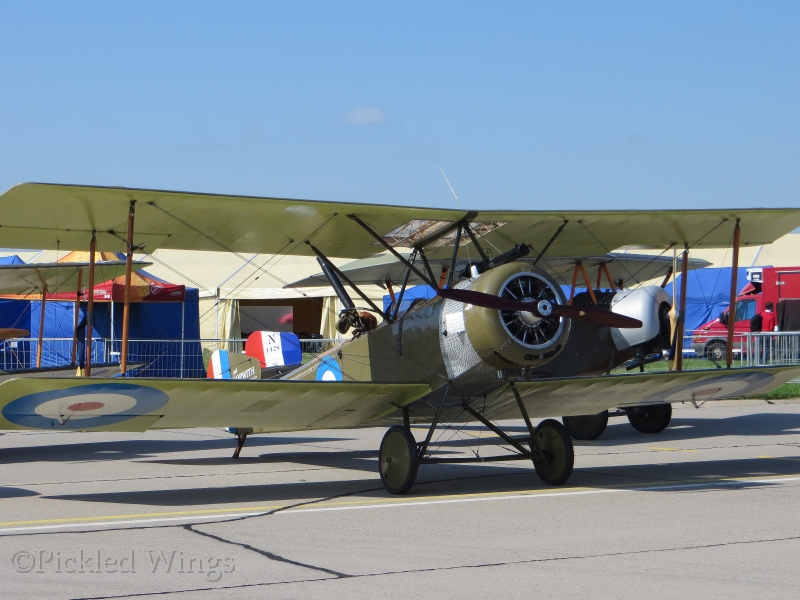
What Remains and Learning More
With a combined total of over 5,900 examples produced between British and French factories, plus smaller numbers built in Russia and Japan, it is surprising that only four original 1½ Strutters are known to survive today.
Two are preserved in France, one of which has been restored to airworthy condition.
A third is displayed in a museum in Belgium.
The fourth is held by The Vintage Aviator Collection in New Zealand and is incomplete.
Fortunately, for those who cannot easily visit one of the originals, several replicas of the 1½ Strutter exist, either displayed in museums or flying at various locations around the world.
The following link will take you to the website of Memorial Flight, home of the airworthy original.
Here are links to 1 ½ Strutter articles on the Warbird Tails and Shortfinals websites.
 Pickled Wings