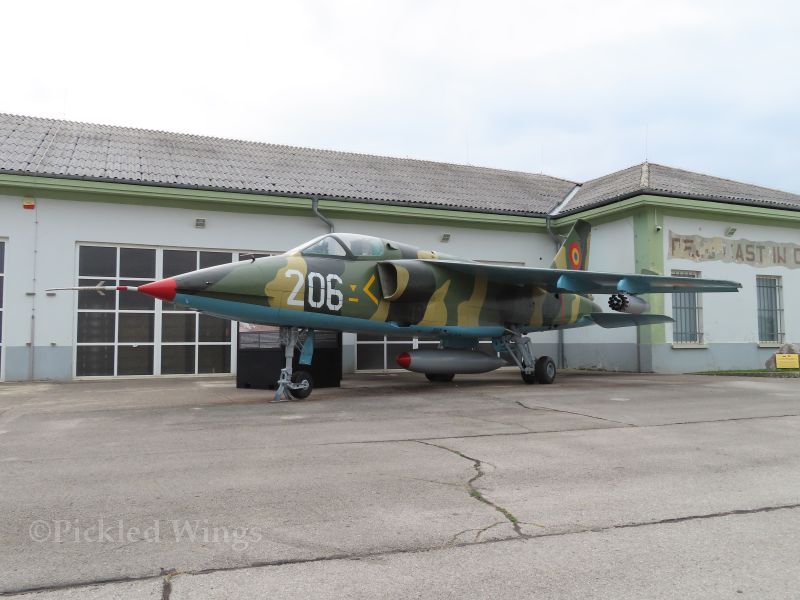
A Striker out of Alignment
In the late 1960s and early 1970s, the former Yugoslavia faced the pressing challenge of replacing its ageing fleet of American-made Republic F-84 Thunderjet fighters, as well as the domestically produced Soko J-21 Jastreb light strike aircraft, which had partially succeeded the Republic jet in Yugoslav service.
The idea of a new domestic aircraft appealed to Josip Broz Tito
(1892-1980), then president of Yugoslavia, and was seen as preferable given the country’s membership in the Non-Aligned Movement, which he had helped establish in 1961. The initial vision was for the aircraft to be offered to other non-aligned nations, providing an alternative to designs originating from NATO or Warsaw Pact countries.
While Soko, the domestic aircraft producer, had experience designing its own aircraft and producing machines under licence from foreign companies, the development and production of a more advanced, potentially supersonic design exceeded Yugoslavia’s capabilities. A partner was needed to share the technical and financial burden.
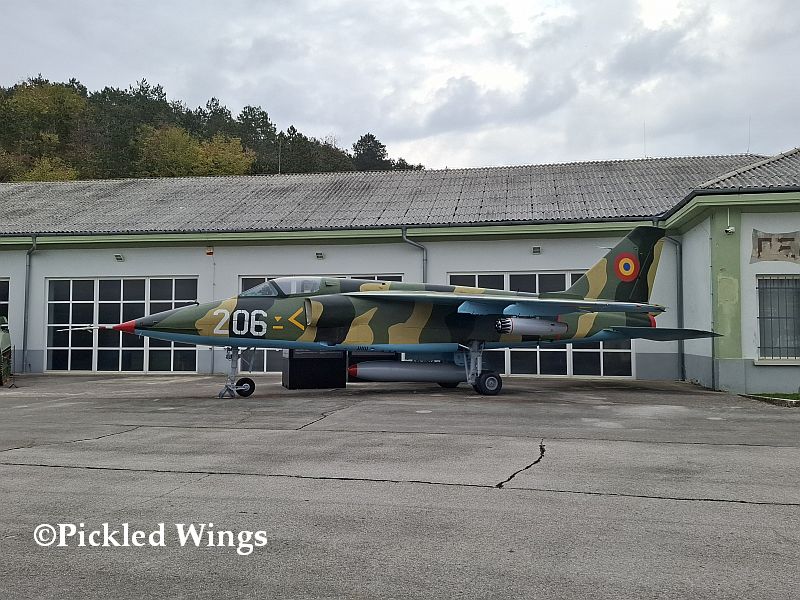
The YuRom Partnership
Romania emerged as a natural partner for the project. Although a member of the Warsaw Pact and governed by a socialist regime, it had ceased to function as a Soviet satellite in 1965 and possessed a level of autonomy in its domestic and foreign affairs not enjoyed by most other Warsaw Pact nations.
Tito’s enthusiasm for a domestically developed combat jet was shared by Romanian President Nicolae Ceaușescu (1918-1989), recognising that the project would provide Romania with valuable experience in modern jet aircraft design while supplying a homegrown replacement for its own fleets of Mikoyan-Gurevich MiG-15 and Mikoyan-Gurevich MiG-17 fighters.
In 1971, the YuRom joint venture to produce the new aircraft was formalised, with research and development commencing shortly thereafter. Soko was the principal Yugoslav partner. Founded in 1950, it had taken over the aircraft division of the older Ikarus company. The main Romanian partner was Avioane Craiova, founded in 1972 specifically to fulfil that nation’s commitments to the programme.
Two principal challenges slowed progress: Romania’s inexperience in jet aircraft design—the nation had a long history of aircraft production but had never produced a jet—and difficulty developing an effective afterburner for the Rolls-Royce Viper engine selected for the aircraft. The engine issue persisted throughout development and, with the exception of a single supersonic flight achieved in a shallow dive in 1984, the aircraft remained subsonic in level flight.
The Romanian and Yugoslav prototypes conducted their maiden flights simultaneously in late October 1974. However, the flight-test programme experienced delays due to accidents and extensive experimentation with wing designs. By the end of the 1970s, three Romanian pre-production aircraft and one Yugoslav aircraft had been lost in crashes. Engine failure caused one accident, while tail flutter—a phenomenon in which part or all of the tail vibrates to structural failure—was responsible for two others.
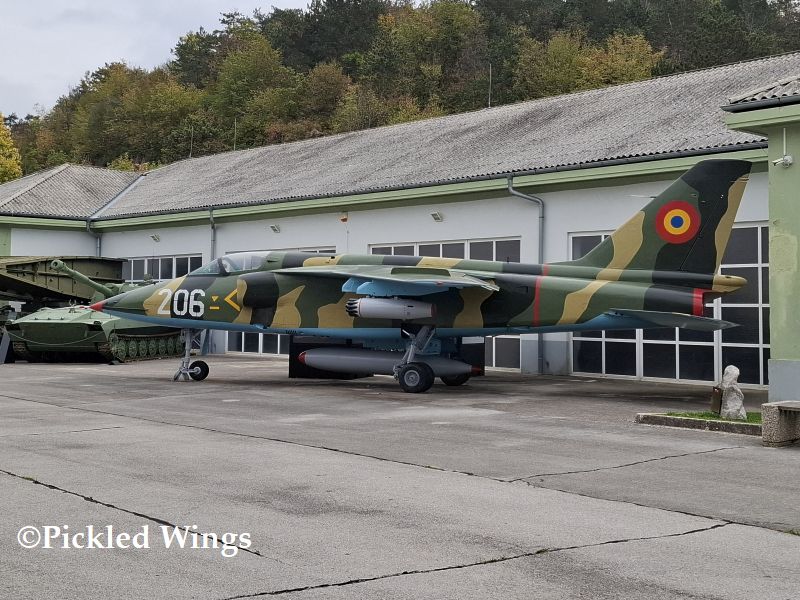
Into Uniform
The aircraft entered service with the Yugoslav Air Force as the Soko J-22 Orao (“Eagle”) in 1978, while its Romanian counterpart, the IAR-93 Vultur (which translates as “Eagle” or “Vulture”), entered Romanian service in 1979.
Developed outside the superpower nations, produced in limited numbers, and operated by relatively small air forces, the J-22 and IAR-93 experienced largely uneventful service lives.
Both aircraft were robust, relatively simple to maintain, and equipped with no exotic avionics or radar. Designed for austere conditions, they could operate from dirt or grass airstrips if required. In terms of role and configuration, they were broadly comparable to the more complex Anglo-French SEPECAT Jaguar strike aircraft, which had entered service slightly earlier.
The Orao and Vultur spent most of their service lives as conventional strike and reconnaissance aircraft. In the strike role, they were armed with a pair of twin-barrel 23-millimetre cannons and could carry a variety of unguided air-to-ground weapons.
Since 2016, Serbia has been upgrading some of its remaining Orao aircraft to enable them to carry more advanced weapons, including laser-guided bombs.
Over the Battlefield
While the IAR-93 never saw combat, the J-22 saw significant use during the Yugoslav Wars (1991–2001), which followed the collapse of Yugoslavia and the fall of socialism.
Initially under the Yugoslav Air Force until its dissolution in 1992, J-22s were deployed against targets in Croatia. During the Bosnian War (1992–1995), several aircraft came under the control of the Republika Srpska Air Force. They were also employed in operations against the Kosovo Liberation Army in 1999.
The impact of the wars and accompanying United Nations embargoes on the aircraft and their manufacturers was starkly contrasting. Romania ceased production of the IAR-93 in 1992 and retired the type entirely by 1998. Avioane Craiova continues to operate today, supporting its IAR-99 jet trainer and offering a range of aviation services.
The J-22 Orao remains in limited service with the Serbian Air Force. Soko’s aircraft factories were targeted and largely destroyed during the Yugoslav Wars, effectively ending aircraft production in the early 1990s. Some assets were later relocated to UTVA, another Yugoslav manufacturer that had collaborated closely with Soko.

In the Eagle’s Nest
While the J-22 and IAR-93 were not identical, certain variants were equivalent. The J-22 remained in service longer, resulting in later Orao versions without Romanian counterparts.
J-22A Orao 1 / IAR-93A / IAR-93A(DC)
- Initial production versions powered by non-afterburning Viper Mk.632 engines.
- J-22A: single-seat only.
- IAR-93A: single-seat; IAR-93A(DC): two-seat Romanian variant.
J-22B Orao 2 / NJ-22 / IAR-93B / IAR-93B(DC)
- Upgraded versions with Viper Mk.633 afterburning engines, increased internal fuel capacity, expanded weapons options, and avionics improvements.
- NJ-22 / IAR-93B(DC): two-seat trainer versions.
IJ-22 Orao 1 / INJ-22 / INJ-22M
- Yugoslav reconnaissance versions based on the J-22A Orao 1.
- Initially non-afterburning; some later upgraded to Orao 2 standard.
- INJ-22: two-seat reconnaissance trainer.
- INJ-22M: two-seat maritime surveillance version with mission-specific avionics and radar; only one was built.
IAR-93BM
- Romanian variant combining IAR-93B capabilities with IAR-93A non-afterburning engines.
- No two-seat versions produced.
J-22M1A / NJ-22M1A
- Serbian upgrade of the J-22B, announced in 2016. Financial constraints have limited modernisation to a small number of aircraft.
- Focused on updated avionics, weapons systems integration, and airframe life extension, with analogue instruments replaced by digital displays.
- The life-extension programme is expected to keep the aircraft operational into the 2040s.
- J-22M1A: single-seat; NJ-22M1A: two-seat.

What Remains and Learning More
With production long ended and fleets steadily reduced, surviving examples have largely transitioned from operational service to preservation.
As of 2026, active J-22s outside Serbia are rare, owing to their small numbers, age, and limited public appearances. Approximately 15 IAR-93 aircraft are preserved in museums in Romania, Slovakia, and Slovenia. A similar number of J-22 Oraos are preserved in museums across Serbia, Bosnia and Herzegovina.
This photo gallery of derelict IAR-93 aircraft in Romania (2006) provides a striking visual record of the type’s post-service condition.
These links will take you to the J-22 article archive and IAR-93 archive at the Afterburner Aviation Magazine website.
 Pickled Wings