
Feeding A Hunger
The interwar period saw a growing public fascination with aviation across many nations. It was during this era that general aviation took shape; the First World War had proven that the aeroplane could be practical rather than merely the plaything of eccentric dreamers, as early aviators were often perceived.
Founded in 1907 and still operating today, the Praga company merged with the Czechoslovak engineering giant ČKD in 1929 and produced several aircraft through the 1930s. Among them was the E.114 Air Baby, developed for the expanding sport-touring aircraft market. It made its first flight in the autumn of 1934 and would see production both before and after the Second World War.
Named in part for its very light weight, and partly to align with Praga’s popular “Baby” line of cars, the Air Baby spent most of its career in the civil aviation sector. It set numerous distance and speed records within its class and won a number of international air rallies. The aircraft became popular in flying clubs and was exported widely, making it one of the most successful Czech aircraft of its time.
Let’s take a closer look at the Praga Air Baby.

Engineering Efficiency
The E.114 was an exceptionally clean, modern, and efficient design for its era. At a time when open-cockpit biplanes with wire-braced, fabric-covered wings and fuselages were still common, the Air Baby stood apart as an all-wood monoplane with an internally braced structure and a fully enclosed cockpit. It featured a one-piece wing and side-by-side seating for two.
The weight savings and aerodynamic efficiency achieved by its wood construction and braced wing allowed the Air Baby to use a much smaller and less powerful engine than many of its contemporaries. The Praga B-series engines installed in the E.114B variants were two-cylinder units producing roughly 40 horsepower. Modest in output, the B-series engines were nonetheless noted for their low fuel consumption.
Following demonstrations across Europe and a showing at the 1934 Paris Air Salon, the Air Baby attracted enough interest for a production licence to be granted in the United Kingdom. Approximately 40 E.114B aircraft were manufactured by F. Hills & Sons Ltd. of Manchester, along with about 135 Praga B-2 engines built under licence by Jowett Cars Ltd. of Bradford. These British-built aircraft were marketed as the Hillson Praga. Several served with a Manchester flight school, while others were distributed across the UK or exported.

Additional interwar developments included the E.114D, powered by a four-cylinder engine, and the E.115 and E.117, both of which featured significant revisions to the wings and fuselage. A single example of the radial-engined E.214 variant was also built.
Although the German occupation of Czechoslovakia halted production, the Air Baby had already left a notable mark on international aviation. Among its interwar achievements were:
- A world record of 1,020 kilometres flown without landing
- A non-stop flight from Prague to Constantinople, 1,560 kilometres
- A record flight from Prague to Moscow, 1,680 kilometres in 15.5 hours
- An English record: London to Cape Town in 16 days
- In E.115 configuration, two straight-line speed records, and altitude records in both single-pilot and two-pilot categories

The Air Baby Family
Air Baby production continued both before and after the Second World War, ending in 1949. Because some of the original construction drawings were partially destroyed during the war, post-war models incorporated noticeable refinements when replacement drawings were created.
There were four members of the Air Baby family:
E.114B / Hillson Praga
Powered by a Praga B two-cylinder horizontally opposed engine producing 40 horsepower, this variant reached a maximum speed of 150 km/h.
The Hillson Praga was the British-built licensed version.
E.114B-2
An E.114B fitted with the slightly more powerful Praga B-2 engine (45 horsepower). Despite the increase, the top speed remained 150 km/h.
E.114D
A pre-war improvement that introduced a Praga D four-cylinder horizontally opposed engine producing 75 horsepower, along with refinements to the flight controls and a larger vertical tail.
The increased power did not raise maximum speed but provided better performance when required.
E.114M
The major post-war variant and final evolution of the Air Baby line. Visually distinct, it incorporated numerous updates from the post-war redesign effort.
The E.114M received a reconfigured wing with noticeably greater dihedral, a tailwheel replacing the earlier tail skid, and most prominently, a Walter Mikron four-cylinder inline engine. The Mikron produced 70 horsepower and gave the aircraft a maximum speed of 185 km/h, making the E.114M the fastest Air Baby model.

Life After War
In 1946, Praga reopened the Air Baby production line with the E.114D and its four-cylinder Praga D engine. The following year, the more powerful E.114M with the Walter Mikron engine entered production as the final member of the family.
Although few pre-war Air Babies—Praga or Hillson—survived the conflict, post-war examples were widely used as touring, training, and glider tug aircraft in several European countries.
Total pre and post war production came to around 275 airframes . The aircraft enjoyed export success to such countries as: Algeria, Australia, Finland, France, Germany, Iran, Italy, Romania and Switzerland.
By the 1960s, as Praga shifted away from aviation and more capable light aircraft entered the market, the Air Baby gradually fell out of use. By the late 1980s and throughout the 1990s, none remained airworthy.

What Remains, and Learning More
The Air Baby has not fared well in retirement, and your chances of seeing one are slim unless you visit the Czech Republic. Of the roughly 275 built, only three complete examples are known to survive.
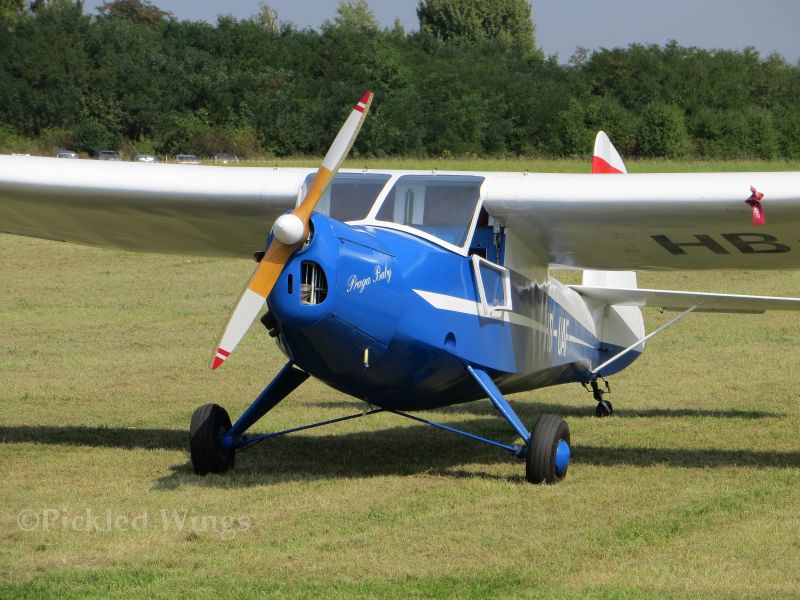
One E.114M was restored to airworthy condition between 2003 and 2009 and placed on the Swiss civil register as HB-UAF. In 2021, it returned to Czech ownership and became part of the air museum collection at Točna Airport in Prague. It also regained its original 1947 registration, OK-BGV.
Another former Swiss E.114M, HB-UAD, was returned to the Czech Republic and reconstructed to E.114B configuration with an original Praga B engine. Now registered as OK-TAU 58, it flew again in late 2015 but was seriously damaged in a non-fatal landing accident in 2017. It has been under extensive repair ever since.
The third surviving Air Baby is an E.114D displayed at the Kbely Air Museum in Prague. It is not airworthy.
Further Reading
OK-TAU 58 — This will take you to a page about the original restoration of the E.114B on the Czech register. It’s in Czech, but respornds reasonably well to online translators.
OK-BGV — This link will open the dedicated page to this aircraft on the Točna Airport website. The link opens in Czech, but there is a button at the bottom of the page to switch between Czech and English.
This article on the Afterburner Aviation Magazine website will also give you more information about the Air Baby.
This article goes into some detail about the Hillson Pragas that were exported to Australia.
 Pickled Wings