A Flustered Falcon
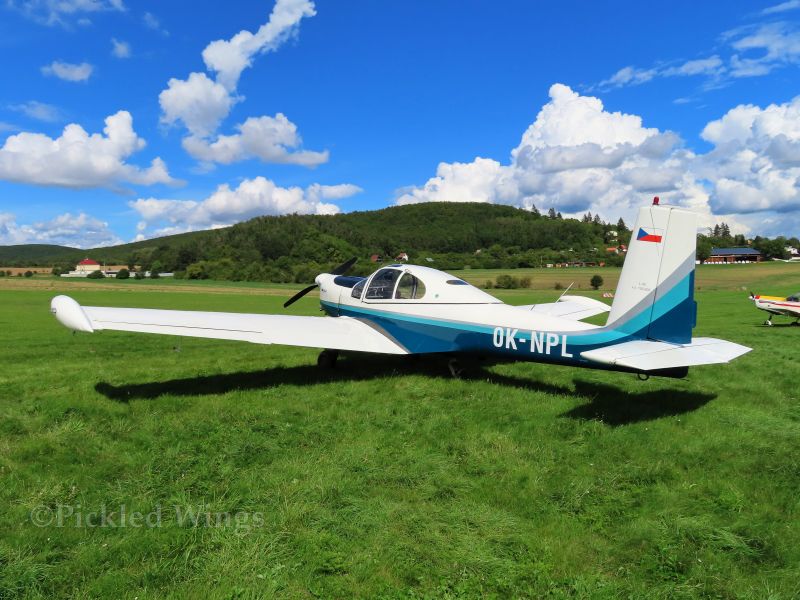
When Orličan’s LD-40 first flew in late March of 1956, it was more than just the prototype of the L-40 Meta Sokol aircraft; it was the successful culmination of a considerable effort to improve upon the Mráz M-1 Sokol (Falcon).
Just as Orličan was a descendant company of the Mráz firm, so too was the Meta Sokol intended to be a descendant of the M-1 Sokol. In both cases, however, neither company nor aircraft was a direct descendant of its forbear, and the correlation to their respective ancestors is therefore rather convoluted.
Orličan had its roots in the pre-war Beneš-Mráz company. During the Second World War, the company was annexed by the Germans and forced to work for the Luftwaffe, emerging from the conflict simply as Mráz. Through a series of nationalizations and mergers of Czechoslovak companies in the late 1940s, Mráz was merged into and passed through several other organizations before finally emerging as the independent Orličan in 1955. One result of this complex lineage is that Orličan aircraft are sometimes credited to other manufacturers in certain references.
Mirroring the evolution of its creator, the L-40 Meta Sokol became a much greater departure from the M-1 Sokol than originally intended. What was envisioned as a refined and improved version of the M-1 ultimately emerged as a completely new aircraft, with little in common with its predecessor save for the Sokol name and the same designer, Zdeněk Rublič.

A Delayed Successor
Designed by Zdeněk Rublič in secret during the Second World War, the M-1 Sokol was Czechoslovakia’s first postwar aircraft design. It was a very clean touring and sport aircraft of laminated wood construction and, by most accounts, a pleasure to fly. Nearly 300 M-1 aircraft were produced across five variants and were successful enough to justify further exploration of the design and development of a follow-on aircraft.
Work on the Sokol’s successor began in October 1949. Changes included full metal construction in place of the M-1’s wooden structure, a new cabin design, and refined wings. Additionally, the new aircraft incorporated a V-tail configuration—famously used by the Beech V-35 Bonanza and the Fouga Magister jet trainer—as well as a distinctive reverse tricycle landing gear arrangement.

The new aircraft, designated XLD-40 Mír, flew for the first time in July 1950 and exhibited decidedly unfavourable handling characteristics. These issues were traced to the V-tail configuration. At the same time, Czechoslovakia’s socialist regime ordered a shift in industrial priorities toward projects that benefited the military. As a result, the XLD-40 was assigned low priority, and any adjustments or further development were carried out on a volunteer basis as time allowed.
By 1953, government priorities shifted once again and work on the XLD-40 was officially reauthorized. With the aircraft returned to higher priority status, development accelerated, and a revised XLD-40 took to the air in August 1954, this time with the V-tail replaced by a conventional tail arrangement.
While the reborn XLD-40 was still not perfect from a handling standpoint, much had been learned during its development. These lessons were applied to the LD-40 pre-production prototype, which flew in March 1956.
Into Production and Around the World
Production of the L-40 Meta Sokol commenced in December 1957 and concluded in December 1959, by which time a total of 106 aircraft had been completed. Approximately 60 percent of these were exported and found use in nearly 20 countries outside of Czechoslovakia. The most significant export customers were Australia, Great Britain, and the former West Germany.
The aircraft was marketed primarily as a light touring aircraft and navigation trainer, with accommodation for three passengers plus the pilot. Like the M-1 Sokol before it, the L-40 possessed pleasant flying characteristics, though it could present a challenge in ground handling when crosswinds were present.
The L-40 was of lightweight construction and offered a respectable range for an aircraft of its engine class. It also incorporated several design features that set it apart from many contemporaries.
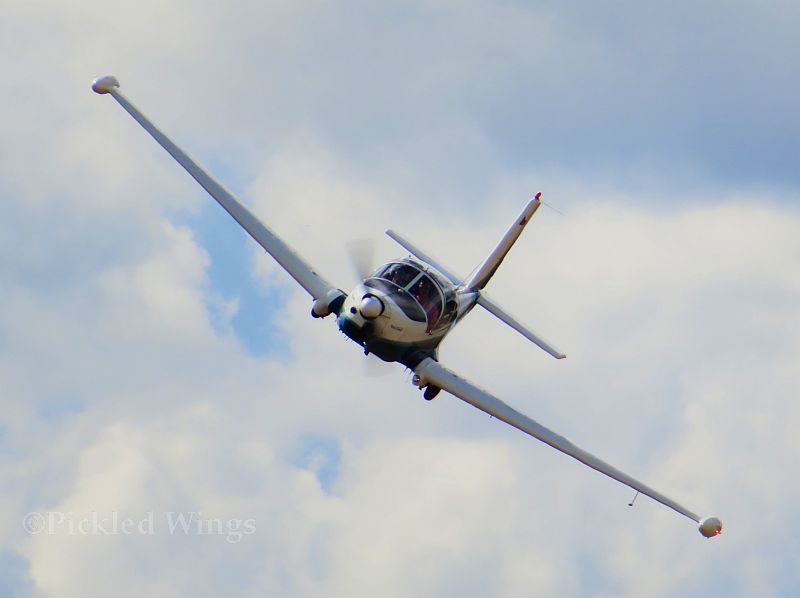
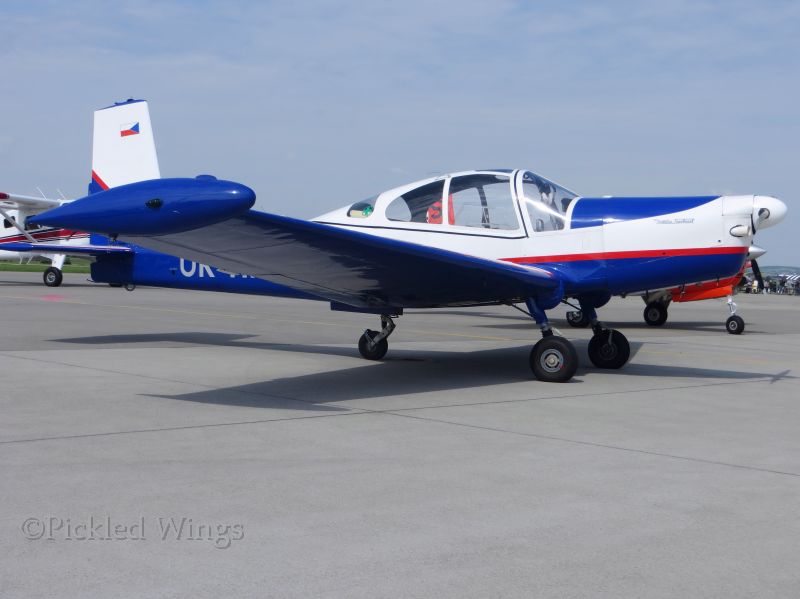
The reverse tricycle landing gear arrangement, so distinctive to the type, was adopted primarily to improve the pilot’s view of the runway during taxiing, takeoffs, and landings. Rather than employing a conventional tricycle landing gear with a nosewheel, the Meta Sokol’s design replaced the M-1 Sokol’s traditional tailwheel with a more robust gear leg positioned just aft of the cabin.

Aside from improved forward visibility, the relocated tailwheel could be fully retracted into the fuselage, improving aerodynamic efficiency in flight. The trade-off of this configuration was a reduced wheelbase, which made the aircraft more sensitive to crosswinds during ground handling, takeoffs, and landings. These characteristics required the pilot to be particularly attentive during these phases of flight.
The L-40 was also designed with a degree of component commonality in mind. The wing flaps and ailerons were not handed, nor were the horizontal tail surfaces. This not only simplified maintenance when replacing parts, but also reduced the amount of tooling required at the factory for their manufacture.
One of the few design features inherited from the M-1 was the main landing gear arrangement, which intruded only minimally into the wing structure. With the exception of a small portion of the tires retracting into unobtrusive hollows in the wing, the remainder of the main landing gear legs simply retracted against the wing surface. This arrangement had the added advantage of reducing structural damage if the aircraft were forced to make a belly landing.
Owing to its short production run and modest numbers, the L-40 existed in only one basic version.
The Meta Sokol Today and Learning More
Due to its relatively small production run, the L-40 Meta Sokol is not a common sight today and has a fairly sporadic worldwide distribution. Happily, as of 2026, several of the type were listed as active on Australian, Czech, German, and Slovak civil registers, with technical support for the type still available.
If you encounter a Meta Sokol, take a moment to enjoy the sight—and perhaps take a few photographs. It may be some time before you see another.
This link will take you to a brief write up of the type in Czech, along with photographs of one of the pre-production prototypes on display at the Kbely Air Museum in Prague. It responds reasonably well to online translation tools.
This link at goodall.com.au offers insight into Meta Sokols that were exported to Australia.
 Pickled Wings