
A Future Giant Cuts its Teeth
The Mil company is arguably the first name that comes to mind when the subject of Russian helicopters is mentioned, this has been the case since the days of the former Soviet Union and the Cold War.
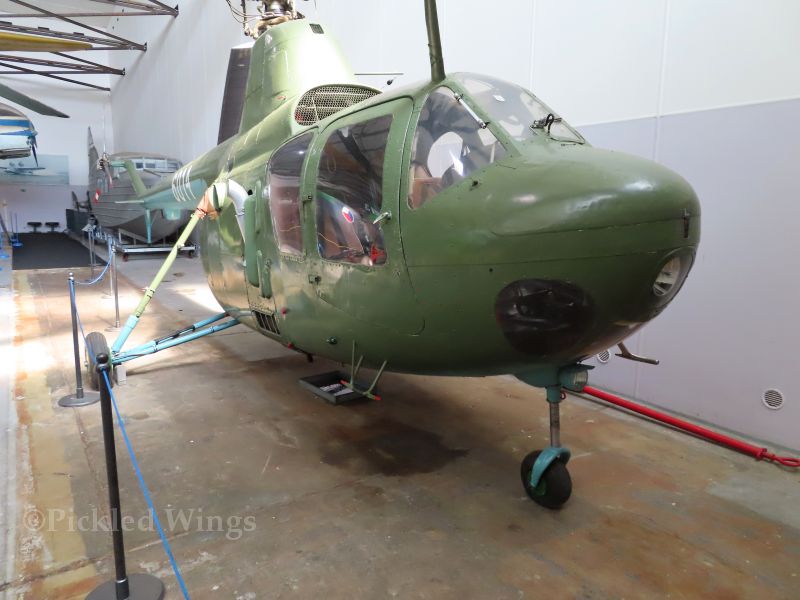
The majority of helicopter designs from the Former Soviet Union or post Soviet Russia have come from the Mil or the Kamov design bureaus; however, it was Mil that was first out of the gate with a practical helicopter design for mass production. That helicopter was the Mi-1, known to the western world by its NATO reporting name: “Hare”.
In a production period that lasted 15 years, more than 2500 examples of the Mi-1 family of aircraft were produced in the former Soviet Union and in Poland. Military and civilian organizations in over 20 countries used the Mi-1.
The Helicopter Comes of Age
The 1950s was a very active time for aircraft development and helicopter technology grew by leaps and bounds alongside more conventional aircraft developments.
Research into practical helicopter designs had already been underway before the Second World War, but it was not until the late 1940s that helicopter designs suitable for mass production began appearing.
The Mi-1 first flew in September of 1948 and was already in production and in service with the Soviet military by the time it was first displayed to the public in 1951.
The Mi-1’s closest western counterparts were the Sikorsky S-51 from America and the Bristol Sycamore from Great Britain; while the three helicopters were contemporaries and broadly comparable in roles and abilities, the Mil design saw longer and larger production runs than the Sikorsky or Bristol machines did.
The Mi-1, like its American and British contemporaries experienced a great deal of variation through the course of its development and production.

A Popular Pioneer
While the Mi-1 was designed as a general purpose helicopter, with communications and liaison as primary duties, it proved itself quite adaptable to a number of other roles during its life.
The Mi-1 family was adapted to such duties as: air ambulance, agriculture, air mail, fisheries patrol, flight training, policing, and arctic ice monitoring among others.
Between 1958 and 1962, Experiments were performed to test the Mi-1 for armed combat. However, such variations of the aircraft did not generate any interest from the Soviet military and were not developed further.
The Mi-1 found users well beyond the confines of the former Soviet Union and the Warsaw Pact; the helicopter found its way to South and Central America, various points in Asia and the Middle East.
The Mi-1’s popularity also translated into remarkable longevity for a first generation helicopter. The last examples of the Mi-1 were retired from Polish and Soviet military service in the 1980s, by which time its Sikorsky and Bristol counterparts had long since been retired from where they served.
The Polish Spin
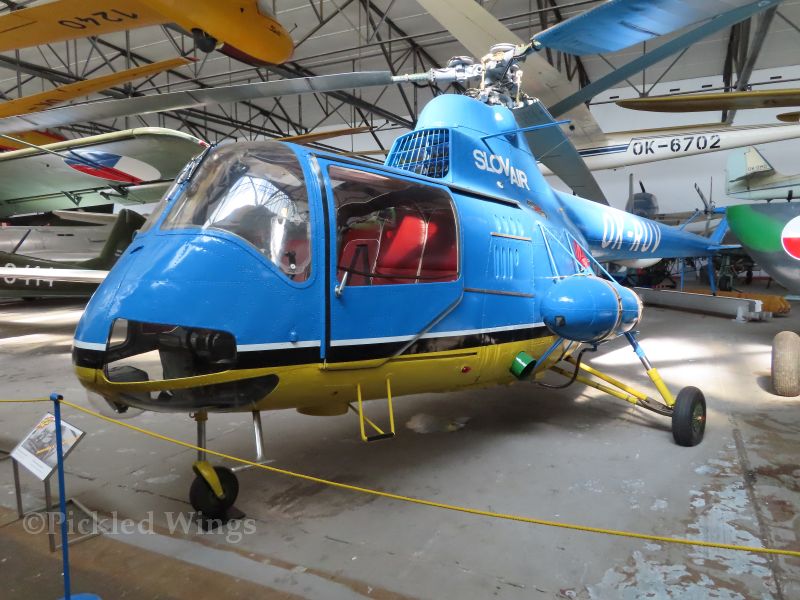
License production of the Mi-1 in Poland began in 1956 and lasted until 1965. The work was carried out by the PZL company at their facility in Swidnik, in eastern Poland.
PZL produced Mi-1 variants were typically equivalent to Soviet built versions, if not always identical. However, the Polish developed the Mi-1 a step further than the Soviets did and created the SM-2 from it.
The SM-2 had its beginings in a 1957 plan to modernize the Mi-1. The SM-2 retained the engine, transmission, rotor, tail section and landing gear of the Mi-1, but incorporated a new cabin section.
The redesigned cabin of the SM-2 was larger and longer than the Mi-1’s and had space for five people, as opposed to the three or four people that Mi-1 variants could carry.
The new cabin of the SM-2 also featured sliding doors which could be opened in flight. This was a distinct improvement over the Mi-1 cabin doors which were hinged and so could not be opened in flight, or needed to be removed before flight if required.
The enlarged cabin also made the SM-2 a much better air ambulance than the Mi-1, as the patient could be carried and attended inside the SM-2 cabin rather than in a pod or stretcher attached to the outside of the Mi-1.
Around 90 examples of the SM-2 were produced. With the exception of five, they were all kept in Poland.

Down the Rabbit Hole
The Soviet standard of the Mi-1 was made in ten major variations plus a few minor ones. This section lists both the major Soviet and Polish variants.
GM-1 / Mi-1
GM-1 was the initial designation for the helicopter when it first flew. It was redesignated as Mi-1 later in flight testing.
Mi-1 was retained as the designation for the initial production version. It had space for the pilot and two passengers and was driven by a 575 horsepower engine.
Mi-1T / SM-1-300
The Mi-1T was the first major improvement on the Mi-1. Improvements included a more reliable engine as well as more complete and better instrumentation and communications gear in the cabin. The Mi-1T also could go much longer between major repair work, around 300 flight hours, than the initial Mi-1 could.
The PZL SM-1-300 is the equivalent Polish made variant to the Mi-1T.
Mi-1TKR
This was a light reconnaissance and liaison variation based on the Mi-1T.
Mi-1NKh
This was a general purpose version based on the Mi-1T. It was used as an agricultural aircraft, air ambulance, passenger transport, air mail, and freight transport helicopter.
Mi-1A / SM-1-600
The Mi-1A debuted in 1957 and was an improved and more reliable variation on the Mi-1T. It retained the three seat arrangement of the Mi-1T. The Mi-1A could fly for 600 hours between major maintenance compared to 300 hours in the case of the Mi-1T.
The Equivalent Polish made version is the PZL SM-1-600.
Mi-1AKR
This was a light reconnaissance and liaison variation based on the Mi-1A.

Mi-1M / SM-1W / SM-1Wb
The Mi-1M debuted in 1957 and featured a four seat cabin and some small refinements of the cabin shape externally.
The SM-1W was the initial Polish made equivalent to the Mi-1M and debuted in 1960.
The SW-1Wb was an improved variation that appeared in 1963, it had increased relaibility and could fly 800 hours between major maintenance work.
Mi-1MNKh
A general purpose version based on the Mi-1M. It was used as an agricultural aircraft, air ambulance, passenger transport, air mail, and freight transport helicopter.
Mi-1M Moskvich
This was a civilian variation of the Mi-1M tailored to the specifications of Soviet state airline, Aeroflot. It had better cabin soundproofing, and metal rotor blades among other refinements.

Mi-1U / TU / AU / MU
These were designations for dual control training versions based on the basic Mi-1, Mi-1T, Mi-1A and Mi-1M.
Designations for Polish made training variants were SM-1Sz and SM-1SWz.
It should be noted that the designation Mi-1MU was used twice for Mi-1 variants; it was used for the training variant as well as for an experimental armed version that never went into production.
SM-1WS
This was a Polish made air ambulance variation based on the SM-1W.
SM-1WZ
This was a Polish made agricultural variant based on the SM-1W.
SM-2
As mentioned in the previous section, this was a Polish specific development of the Mi-1M that addressed shortcomings of the cabin design.
The Mi-1 today and Learning More
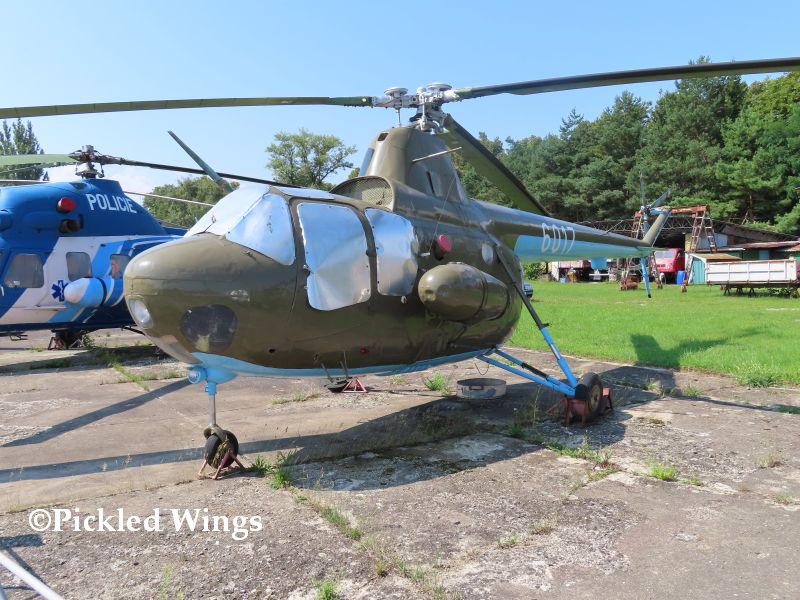
Of the more than 2500 examples of the type built, several are available for viewing in museums worldwide.
An Mi-1 was returned to flying status in Russia in 2013. As of spring 2024, that aircraft is still actively flying on the Russian civil register.
These links will take you to articles about the SM-1 and SM-2 at the website of the Polish Aviation Museum in Krakow. Both articles are in Polish, but they respond well to online translator functions.
These links will take you to articles about the Mi-1A and Mi-1MU at the website of the Czech Military History Institute. Both articles are in Czech, but respond well to online translator functions.
 Pickled Wings