
The Junkers Legacy
As German aircraft manufacturers go, Junkers is one of the most legendary.
Company founder Hugo Junkers (1859–1935) was a mechanical engineer who began his career developing boilers, heaters, radiators, instruments, and a variety of engines. He held many patents connected to thermodynamics and metallurgy.
In 1895, in Dessau, he founded Junkers & Co. to further develop his inventions.
Junkers’ interest in aviation began in the late 1800s and early 1900s. At the time, he was working as a professor of engineering at the Technical University of Aachen. His growing focus on aviation caused friction with the university, which wanted him to concentrate on lecturing. Junkers left the university and returned to his company in Dessau in 1912.
Together with Hans Reissner (1874–1967), a fellow professor he met at Aachen, Junkers created the world’s first all-metal aircraft. The design was primarily Reissner’s, while the construction was carried out by Junkers in Dessau.
Junkers’ first aircraft design, the J 1, first flew in 1915. The J 1 made clear that Junkers was ahead of his time in aircraft design. In a world where aircraft were still frail biplanes with wooden frames covered in cloth and supported by struts and wires, the J 1 was an all-metal monoplane with an internally braced wing.
Junkers spent the 1920s making a name for himself with all-metal passenger aircraft designed with airlines in mind. His insistence on producing only civilian aircraft put him at odds with the Nazi Party after it took power in 1933. The regime wanted Junkers to design and produce military aircraft, which he refused to do. As a result, he soon found himself in conflict with the state to maintain control of his company.
By the end of 1933, Junkers was completely separated from his company. Most of his shares and many of his patents were forcibly taken by the state. By 1934, he was living under house arrest.
Hugo Junkers died in February 1935. Shortly afterwards, his widow, Therese, was forced by the state to give up any remaining shares she held. This marked the end of Junkers family ownership or influence.
The Nazi government retained the Junkers name and created aircraft Hugo Junkers would never have approved of, such as the infamous Ju 87 Stuka dive-bomber, the Ju 88 bomber, and militarized versions of the Ju 52 airliner.
Some sources refer to Hugo Junkers as a pacifist. However, this is a broad and overgeneralized statement. He had willingly designed and built aircraft for the German air force and navy during the First World War; it was only afterwards that he refused further involvement in military projects. Junkers was very research-driven and disciplined in advancing the science of aviation and, according to some sources, felt that military goals were incompatible with his own. From that perspective, it may be more accurate to call him a purist than a pacifist.
The Junkers company survived the war and was eventually absorbed into Messerschmitt-Bölkow-Blohm (MBB) in 1969 through a series of mergers.
In 2015, the Junkers name returned to aviation with the formation of Junkers Aircraft AG. The company began as a project between the Rimowa luxury luggage brand and Junkers family heirs with the aim of creating a modern flying replica of the F 13. The company also produces modern flying replicas of the Junkers A50 Junior, a sport aircraft from the late 1920s.

Breaking Conventions and Rules
As mentioned earlier, Hugo Junkers had his own approach to aircraft design that was markedly innovative compared to that of his contemporaries.
He pioneered full-metal monoplane designs with internally braced wings at a time when biplanes made of wooden frames and fabric coverings were the norm.
Junkers was known for a diligent, responsible, research-driven approach to design. He recognized the many advantages metal offered over wood—beyond durability, metal was a predictable, consistent material, while wood varied greatly in quality. Metal also provided much better fire resistance, making all-metal aircraft safer for occupants in emergencies.
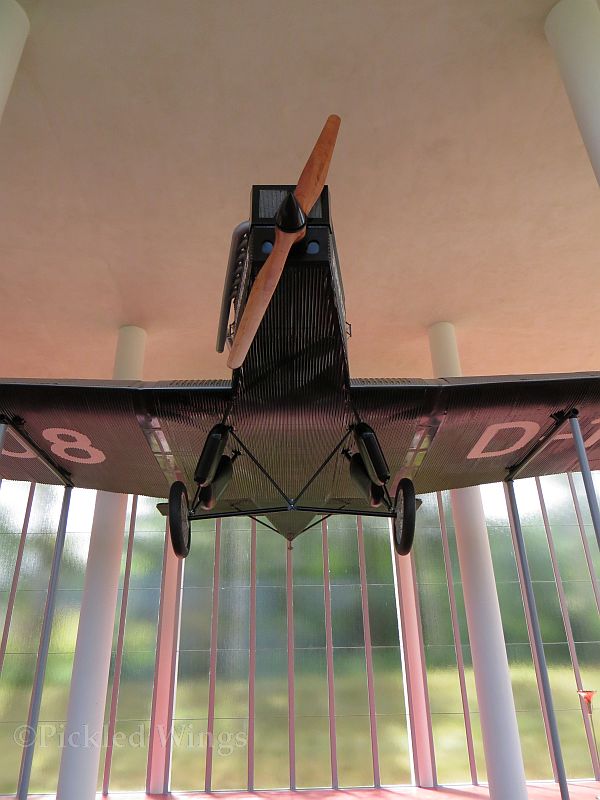
Junkers used corrugated metal sheets as skin for his aircraft. The corrugations added structural strength by increasing resistance to torsional forces, thereby extending the serviceable life of the aircraft.
While his earliest metal aircraft were made from iron or steel, Junkers quickly shifted to using Duralumin. Introduced in 1909, this aluminum-copper alloy became widely appreciated for its lightness and durability in aviation as well as other industries. While the name “Duralumin” fell out of use, the alloy type is still widely used today.
Junkers had the distinction of creating the first aircraft of primarily Duralumin construction that was designed for mass production: the Junkers J 4. Debuting in 1916, the J 4 was an attack and observation aircraft used by the German military. A total of 227 were built, and they were popular with their crews by most accounts.
By the time the F 13 was conceived, Hugo Junkers and his team had built the experience and know-how they needed to create a genuine aeronautical breakthrough.

Blazing a Trail
The interwar period saw the birth of the airline industry. While air travel would not become accessible to the general public until after the Second World War, it was already a highly competitive industry in its early years.
Most early airliners were surplus First World War bombers modified to carry passengers. Examples included passenger versions of the Airco DH.9, Handley Page Type O, and Vickers Vimy in Great Britain, as well as the Farman F.60 Goliath from France. These aircraft could transport passengers, but they were undeniably improvisations.
Early purpose-designed airliners were usually conservative biplane designs of mostly wood and fabric construction. They worked, but were slow and poorly suited to a wide range of climates.
The Junkers F 13 first flew in June 1919 and was the world’s first purpose-designed airliner. Unlike its contemporaries, there was no improvisation or conventional thinking in the F 13. From the ground up, it put passengers and modernity first. The aircraft had a well-appointed, fully enclosed cabin for four passengers with heating, noise suppression, and seat belts.
Compared to its contemporaries, the F 13 was a complete revelation. Its monoplane design and corrugated metal skin gave it aerodynamic efficiency that made it not only faster but also more fuel-efficient, as it required less engine power for takeoff and cruising.
While the landing gear was fixed with a tailwheel, typical of the era, it incorporated more modern shock absorption and handled rough landings better than most competing aircraft.
Perhaps the only concession Junkers made to the conventions of the day was the open cockpit. Many pilots preferred open cockpits that allowed them to feel the air on their faces and fly intuitively rather than rely completely on instruments.
Another advantage of the F 13 was its adaptability. It was designed to easily accommodate floats or skis, as well as a range of engine types. This flexibility would be a major selling point as the world took notice—and that would not take long.

Going Global
The Treaty of Versailles was signed only days after the F 13’s first flight. The restrictions it placed on German aviation and other industries in the early 1920s forced Junkers to seek locations outside Germany to build and sell the F 13.
Junkers secured production or assembly facilities in Estonia, Poland, and the former Soviet Union. Additionally, he co-founded the Junkers-Larsen Corporation in the United States in 1920 to carry out final assembly and sales in North America.
After 1923, restrictions eased and Junkers brought production back to Dessau.
Before 1919 ended, Junkers already had orders for the F 13 from buyers in Austria, Poland, and the United States. The early 1920s brought orders from Colombia, France, Italy, Japan, and the United Kingdom.
The order from Colombia was especially significant as it was for Sociedad Colombo Alemana de Transportes Aéreos (SCADTA). SCADTA was the second airline in the world and the first in South America; it is an ancestral company of Avianca, Colombia’s current national airline.
The F 13 suited SCADTA extremely well. Its all-metal construction was much more durable in tropical environments than traditional wood and fabric. Where wood and cloth tended to rot in humidity and were vulnerable to termites and other insects, the F 13’s metal construction and durable paint coatings made it practically immune.
In the early days of aviation, airports on lakes, rivers, and other waterways were more common than land-based airports in South America. Combined with the availability of factory-designed floats, this made the F 13 especially attractive on that continent, where dense forests meant that lakes and rivers were often the only places to land.
Many F 13s were sold to civilian and military operators across South America. The very last commercial F 13 flight took place in Brazil in 1951. It speaks volumes about the quality and versatility of the design that it could be introduced at the start of the rapidly advancing interwar period yet remain commercially viable into the early post-war era.
Taking Care of Business
The Junkers F 13 was not only the world’s first purpose-designed airliner—it can also be seen as one of the world’s first corporate aircraft.
In the former Czechoslovakia, the Baťa company was one of the world’s first corporate aviation users. With several factories across Europe, company founder Tomáš Baťa purchased a Junkers F 13 to efficiently shuttle himself and his executives between company locations and to meet clients.
In 1932, Tomáš Baťa lost his life when the company’s F 13 crashed just after takeoff.
In North America, the F 13 proved popular with mining and oil companies, which used it to transport executives between offices or to remote mining and drilling sites. It also served as a useful survey aircraft.
In both commercial and corporate circles, the F 13 proved popular enough to warrant further development. It served as the basis for the larger W 33 and W 34 transports, which debuted in 1926 and went on to enjoy global success comparable to the F 13.
In 1928, a Junkers W 33 became the world’s first aircraft to complete a non-stop east-to-west transatlantic flight.

What Remains and Learning More
From a total of 322 built, five original F 13s survive today in museums in Canada, France, Germany, Hungary, and Sweden.
Non-flying replicas are known to be on display in the Czech Republic and Germany.
At the time of writing in early 2025, three flying F 13 replicas exist. To see one in flight, you’ll need to attend an event where a replica is scheduled or travel to one of their bases: one in the United States and two in Switzerland.
However, seeing one may be easier said than done. They are hand-built and cost around 2.5 million USD, so it is unlikely many more will be produced.
The replicas are true labours of love. Creating them required extensive research and the re-learning of lost fabrication skills. They are as true to the original specifications as modern aviation regulations allow.
This link will take you to the documentary film The Return of the Junkers F13
on YouTube. It runs about 100 minutes and gives excellent insights into the replica project from conception to the flight of the first aircraft.
To learn more about Hugo Junkers and his legacy, you can visit the website of the
Hugo Junkers Technical Museum in Dessau. The website is in German, but it generally responds well to online translation tools.
 Pickled Wings