
The Push for More
Aerobatics is a type of flying that has been with us almost since the dawn of powered flight. This is hardly surprising, given humanity’s tendency to push boundaries and test the limits of technology. In civilian aviation, specialist aerobatic aircraft are the ultimate expression of that drive.
Competition-level aerobatics is divided into four main categories: Sportsman, Intermediate, Advanced and Unlimited. Aircraft in the Unlimited class are purpose-built to maximize performance, often at the expense of all other capabilities. They are engineered to be light-weight and to deliver high thrust, allowing them to execute extreme maneuvers without tearing themselves apart.
Such aircraft are not for novices. Unlimited class pilots typically have amassed hundreds of flight hours. They will also be a very physically fit, worthy of being considered top-level athletes.
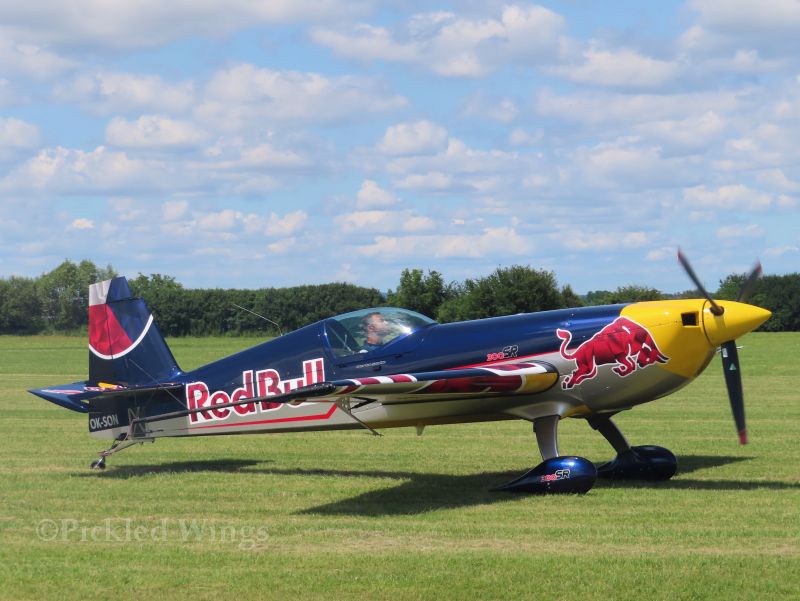
The Extra 300 first flew in 1988 and became an iconic machine in the Unlimited category throughout the 1990s. Let’s spend some time with this remarkable aircraft:
An Insider’s Knowledge
The Extra 300 was designed by Walter Extra (1954-), an award-winning aerobatics pilot from Germany who established his own aircraft company in 1980. Extra Aircraft is located near the Rhine river in the town of Hünxe, in the North Rhine-Westphalia state of Germany.
Dissatisfied with the limitations of existing designs, Extra set out to build something better. His experience as a competitive pilot and his education in mechanical engineering made this possible.
The first aircraft developed by Extra Aircraft was the Extra 230, which first flew in 1983. While the Extra 230 was the direct ancestor of the 300, its lineage can be traced back further.
The Extra 230 and 300 are extreme developments of the Stephens Akro, an American aerobatic design from the late 1960s. The Stephens Akro, though rudimentary compared to the Extra designs, was a successful design that was possible to homebuild and lent itself to modification.
The basis of the Extra 230 design was the Akro Laser Z-200, a one-off modification of the Akro. It was piloted by American Leo Loudenslager (1944-1997) and won several championships between 1975 and 1982.
The Extra 230 was conventional in design, featuring a tube steel frame fuselage with wooden wings. A refined version called the Extra 260 was also created, though few were made.
Produced from 1983 to 1990, the Extra 230 gained popularity and set the stage for the watershed event that the Extra 300 would be to the aerobatics world.

The New Standard
The leap from the Extra 230 to the 300 was driven by the same principles that guide all aerobatic innovation: reduce the weight, and increase the power. However, it was more than just aerial competition that led Extra to create what would become their flagship product. Changes in materials and manufacturing processes also played a major role.
While the 230 had some carbon fiber composite structures, the 300 featured a fully carbon fiber composite wing. Though light, plywood was maintenance-intensive and inconsistent in quality. Walter Extra switched to carbon composites after struggling to source suitable plywood. This decision benefited both the factory and the end users.
The change of materials improved manufacturing efficiency and quality control while offering users a lighter, stronger, and more consistent wing. Maintenance demands decreased, and performance improved.
Another advantage of the Extra 300 is its two-seat design, a rarity in the Unlimited class. This makes it ideal for training and experience flights. While nobody could accuse the Extra 300 of being a novice’s aircraft, it is considered pilot-friendly for its class.
The 300 gained popularity in both individual and team aerobatics. Civilian teams around the world use it, and it also serves as the aircraft for the military air demonstration teams of Jordan and Malaysia. The Chilean Air Force used members of the 300 family from 1990 to 2020.

The Extra 300 Family
Since its first flight in 1988, the Extra 300 has undergone more evolution than perhaps any other aircraft in its class. For an Unlimited class design to have a three-decade lifespan and still be in production and competitive is truly remarkable.
As of mid 2020, almost 800 examples of the 300 had been built across a dozen variants and sub-variants:
Extra 300 / 300 S / 300 SP
- The 300 is the baseline two seat model powered by a 300 horsepower Lycoming engine.
- The 300 S is a single-seat variant with a reduced wingspan and refined flight controls.
- The 300 SP is a lighter version of the 300 S with a 330 SX rudder fitted to it.
Extra 300 SR
- The 300 SR is a racing version with a wing optimised for the Red Bull Air Race series (2003-2019)
Extra 300 L / 300 LP
- The 300 L is the most produced variant of the 300 family. It’s a two-seater with low-mounted wings for easier cockpit access.
- The 300 LP is a lighter, higher-performance version aimed at competition.
Extra 330 SC / 300 SX
- The Extra 330 SC is a top-tier single-seater with an enhanced roll rate. It is the apex of the Extra 300 design, flying to victory in the World Aerobatics Championships nine times (2009, 2013, 2014, 2015, 2016, 2017, 2019, 2022, 2023).
- The 330 SX, introduced in 2023, features further refinements including a roomier cockpit.
Extra 330 LX / 330 LT
- The 330 LX is a two-seat version of the 330 SC.
- The 330 LT is a touring version. It keeps most of its aerobatic abilities, and includes baggage space as well as all the required avionics for cross-country flying.
Extra 330 LE
- A single-seat electric version first flown in 2016, powered by a Siemens motor. It set speed records in 2017 and was the first electric aircraft to tow a glider. Since the early 2020s, it has been part of the Deutsches Technikmuseum collection in Berlin. Germany.

The New Breed
In 2019, Extra Aircraft unveiled the Extra NG, a fully new aerobatics machine intended to succeed the Extra 300 family.
The NG features full composite construction, enhanced speed and acceleration, and a more refined aerodynamic profile. It includes ergonomic improvements like a larger, quieter cockpit and improved outward visibility.
Modern upgrades include a touchscreen control panel and autopilot, which makes life easier for the pilot on long transit flights between events.
As of June, 2025, around 80 examples of the NG had been produced.
The Extra 300 Today
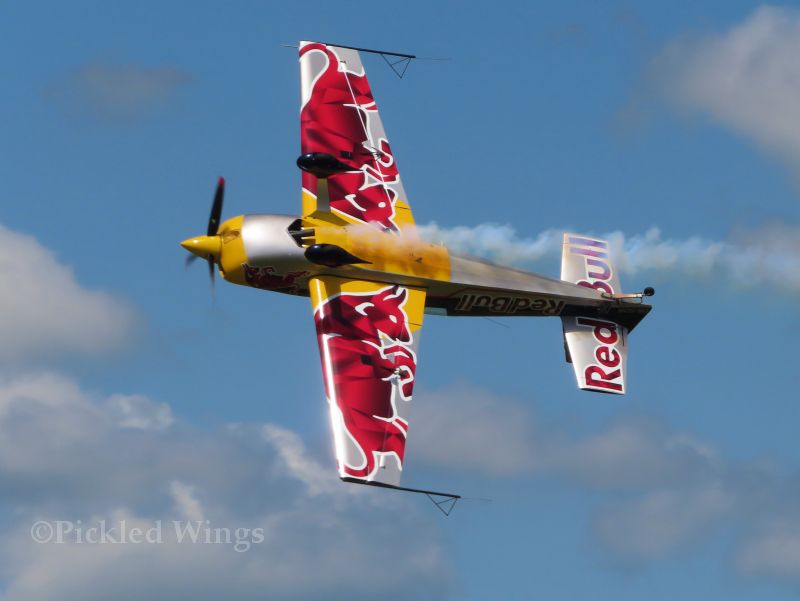
With a legacy spanning more than three decades, the Extra 300 remains a cornerstone of aerobatics. Over 800 examples had been built as of early 2025, and a strong demand exists for members of the family on second-hand markets,
Still a formidable competition aircraft and a crowd-pleaser at airshows, the Extra 300 family is far from flying into the history books.
Learning More
- Extra Aircraft — Official website of Extra Aircraft
- Royal Jordanian Falcons — Website of the Jordanian air force demonstration team
- Mélanie Astles — Website of champion French aerobatics and air racing pilot
Acknowledgment: Special thanks to Extra Aircraft for supplying valuable information that enhanced this article.
 Pickled Wings