
Brothers on the Wing
The Caudron aircraft company was established in 1909 and was among the earliest of French aircraft manufacturers. It was named after the Caudron brothers, Alphonse “Gaston” (1882-1915) and René (1884-1959), who founded it.
Caudron operated from 1909 until 1944 and produced a number of aircraft designs in both civilian and military categories. The company became internationally recognised, and several Caudron aircraft types achieved great success on export markets or were built under licence.
Caudron became best known for its sports and training aircraft. The company operated a flying school as early as 1910 and was a major player in various categories of air racing in the 1920s and 1930s.
During the interwar period, the French Air Ministry sought to consolidate the nation’s aviation industry by reducing the number of smaller companies. The automotive manufacturer Renault was beginning to branch into aviation, and the Air Ministry put pressure on Caudron to merge with Renault.
In 1933, Renault purchased a majority share of Caudron, and the aircraft manufacturer became a subsidiary. of Renault. In 1937, Renault acquired the remaining shares.
During the Second World War, Caudron-Renault produced the German designed Messerschmitt Bf-108 and Siebel Si-204 aircraft as well as aircraft from their own Simoun and Goéland utility families. The Caudron-Renault aircraft factory was destroyed by Allied bombing in September 1943.
In 1944, the French government nationalised what remained of Caudron and merged it into SNCAC (Société Nationale de Construction Aéronautique du Centre), a company created in 1936 by the nationalisation and merger of the Farman and Hanriot aircraft companies.
The story of the Caudron aircraft company came to an end with its incorporation into SNCAC.
Throughout its existence, Caudron was well respected as an aircraft manufacturer. Its aircraft were known for being well-designed, with good handling characteristics and performance.
An early example of Caudron’s quality was the G.3 model. It was one of the first mass-produced French aircraft and was popular with pilots of many nations during and after the First World War.
Let’s spend some time with the Caudron G.3:

Able and Available
The Caudron G.3 first flew in late 1913 and entered French air force service in early 1914. At least one squadron was active at the outbreak of the First World War in July 1914.
Primarily designed for reconnaissance, the G.3 was well suited to the role, offering excellent climb rate, stability, and controllability.
The G.3’s performance and handling led to high demand shortly after the conflict began. Licences for production were granted in Great Britain and Italy. Almost 2,500 examples were built across French, British, and Italian lines.
The popularity of the G.3 is unsurprising when considering that it was a refined design by the time of World War One’s outbreak. It was part of Caudron’s G series, following the single Type G prototype and the more developed G.2. By the time the G.3 emerged, it was a well-matured machine with most early flaws corrected.
The G.3 represented the midpoint of G series development and was the final single-engined member. It formed the basis for the larger twin-engined G.4 bomber (1915) and the G.6 reconnaissance aircraft (1916).
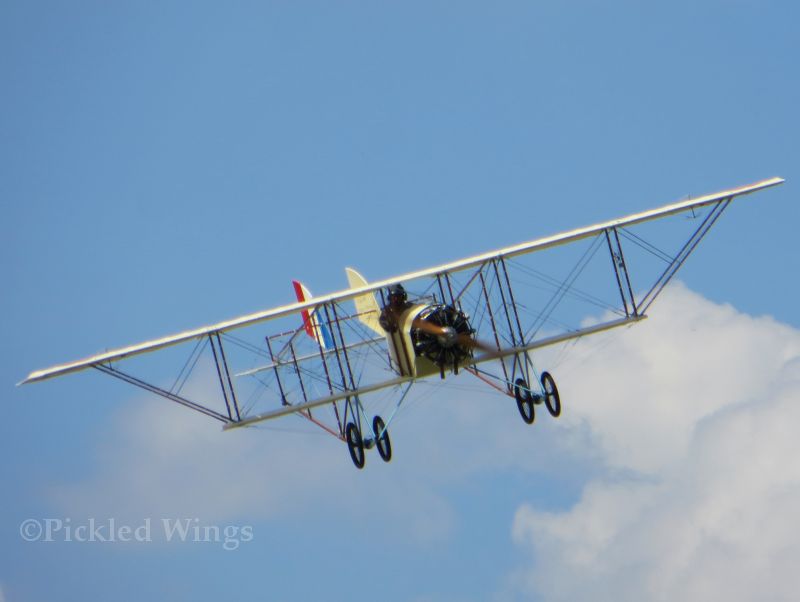
A shared design feature of the G series, contributing to the G.3’s performance and handling, was the wing configuration. The aircraft were sesquiplanes, meaning “one and a half wings” in Latin. Unlike traditional biplanes with near-identical wings, sesquiplanes had a much smaller lower wing. Lateral control was provided by the upper wing, while the lower wing mainly generated lift.
In the early 20th century, sesquiplane designs offered advantages over both biplanes and monoplanes. These included weight savings from reduced material use and less interference in airflow between the wings, improving control.
Monoplanes at the time were fragile and required bracing wires for structural strength. Sesquiplanes offered similar weight advantages while maintaining the structural integrity typical of biplanes.
For reconnaissance, the smaller lower wing improved downward visibility. Lateral movement was initially controlled by wing warping—physically twisting the wing—which reduced wing lifespan. Later production G.3s were fitted with separate ailerons, allowing for stronger wing structures and better control.
On the Front Lines
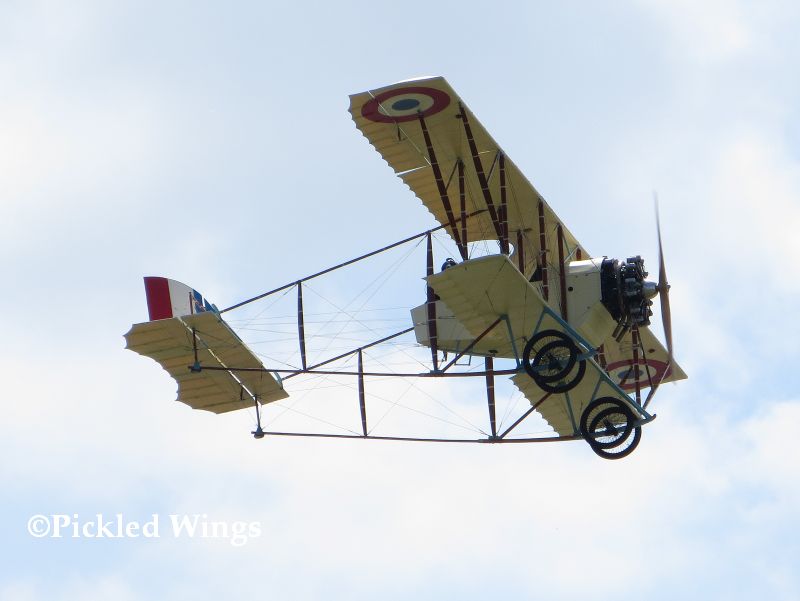
The G.3 served on the front lines until summer 1916, when it was reassigned to second-line duties due to obsolescence. Nevertheless, it performed admirably during its time in frontline service.
Its excellent climbing ability made it popular with Italian forces, particularly in the mountainous north. Italy used the G.3 widely until 1917. British forces, including the Royal Flying Corps and Royal Naval Air Service, also used it until at least 1917.
The G.3 saw service on both the Eastern and Western fronts, as well as in the Middle East and the Balkans. In addition to France, Great Britain, and Italy, it was operated by Australia, Romania, Russia, and the USA during the war.
Generally unarmed, the G.3 could be fitted with defensive guns and light bombs. From mid-1916, it was withdrawn from reconnaissance roles as newer aircraft outclassed it and it became vulnerable to air and ground attack.
Relegated to training duties, the G.3 remained in service in that capacity well beyond the war’s end.
Fledglings and Firsts
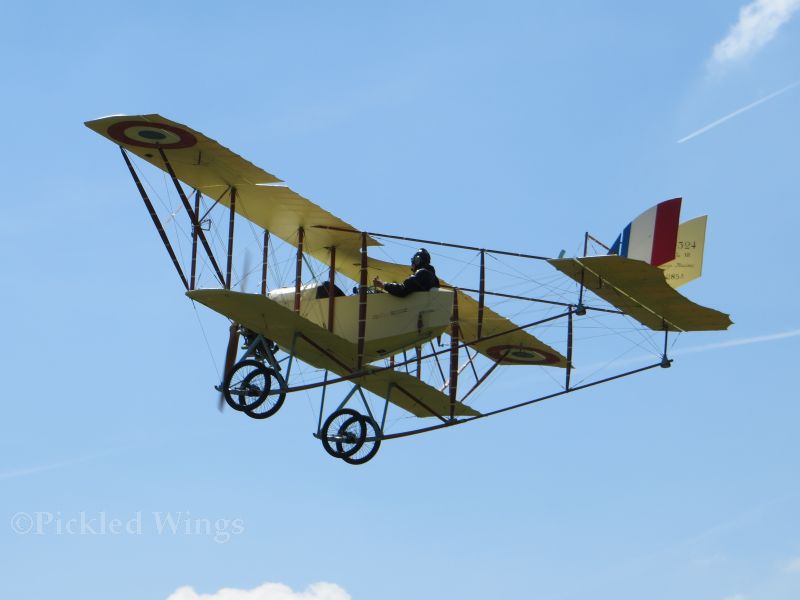
The First World War demonstrated aviation’s military value, prompting many nations to establish air arms—often branches of the army or navy, as fully independent air forces were rare at the time.
The G.3 was operated by around thirty national air arms. In several cases, it was their first military aircraft. For instance, the Colombian air force used G.3s as trainers in the early 1920s.
In Portugal, the post-war Army Military Aeronautical Service adopted the G.3 as a main training aircraft. Its maintenance ease and good handling led the Portuguese Parque de Material Aeronáutico (Aeronautics Material Depot) to build fifty new examples between 1922 and 1924.
The G.3 featured in several aviation milestones. Swiss aviation pioneer François Durafour (1888-1967) used one in 1919 for the first commercial flight between Paris and Geneva—an airmail run lasting four and a half hours.
On 30 July 1921, Durafour landed a G.3 on the slope of Dôme du Goûter, near Mont Blanc, at 4,331 metres (14,209 feet). It was the highest point at which an aircraft had landed and taken off, and the first on snow—a record that stood for thirty years.
In 1921, French aviatrix Adrienne Bolland (1895-1975) made a daring crossing of the Andes in a G.3. While not the first such crossing, it was a major achievement that cemented her place in aviation history.
Employed by Caudron to demonstrate their aircraft in South America, Bolland flew from Argentina to Chile on 1 April 1921. The flight lasted just over four hours and nearly ended in tragedy. She had requested a more suitable aircraft, but Caudron declined. With no map and little knowledge of the terrain, she navigated treacherous valleys in an aircraft unable to fly above many of the surrounding mountains.
Despite a near-collision with a mountainside, Bolland completed the flight successfully. Fortunately, the aircraft was sold in Chile, allowing her to return to Argentina by train.
What Remains and Learning More
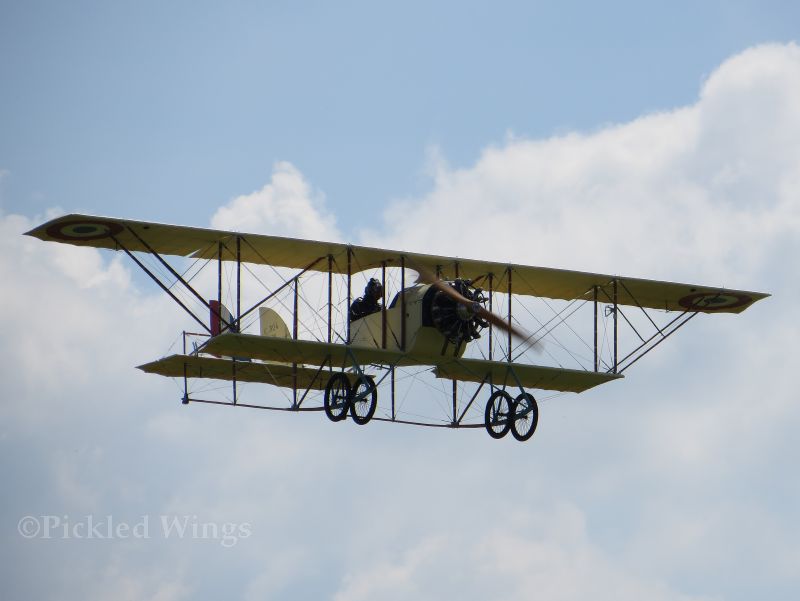
The G.3 demonstrated remarkable longevity. Though in service from the outbreak of the First World War, examples remained operational into the late 1920s and early 1930s. The Portuguese military retired their last G.3s in 1933.
The G.3 saw wide geographic use, including in Europe, South America, China, Japan, Australia, and New Zealand.
Original G.3s are preserved in museums in Belgium, Brazil, Finland, France, the United Kingdom, and Venezuela. Flying replicas exist in the Czech Republic, France, and the United States.
This article on the Museu do Ar website discusses the G.3 in Portugal.
This Aeropedia article offers further detail about the G.3 in Australia and New Zealand.
 Pickled Wings