
Beneš-Mráz: Short-lived, but Successful
The name Beneš-Mráz may not be well known outside the Czech lands; the company only existed from 1935 to 1939. However, in that short window of time, it produced no fewer than 14 aircraft designs for the civil market.
The firm was founded by accomplished aviation engineer Pavel Beneš and businessman Jaroslav Mráz. Before partnering with Mráz, Beneš had co-founded the famous Avia company in 1919 with fellow engineer Miroslav Hajn. He also spent time working in the aircraft division of the Praga company before joining forces with Mráz in the mid-1930s and establishing a factory in Choceň, in the northern part of today’s Czech Republic. By 1939, Beneš had divested his share of the company, which was renamed Mráz to reflect the change in ownership.
Through the German occupation during the Second World War, the rise and fall of socialism, and a number of name changes over the years, the legacy of Beneš-Mráz has carried on. Today it lives through Orličan a.s., a sailplane manufacturer that continues to operate in its ancestral home of Choceň.

The Be-50 Beta Minor: A Solid Start
The summer of 1935 saw the first flight of the first aircraft designed by the newly established Beneš-Mráz company: the Be-50 Beta Minor.
Intended for touring, training, and sport flying, the Beta Minor proved an excellent start for the firm. It was a clean design with forgiving handling qualities, making it popular with Czechoslovak flying clubs of the time.
With much of its structure built from wood, the Beta Minor was light yet sturdy at only 460 kilograms. Powered by a domestically designed-and-built Walter Minor four-cylinder engine, it could reach a very respectable top speed of 195 kilometres per hour. A combination of low weight and efficient aerodynamics gave it a range of up to 750 kilometres without refuelling. The aircraft also performed admirably in several distance-based air races in the late 1930s.
More than just a pilot’s aircraft, the Be-50 was also valued for its mechanical reliability, ease of maintenance, and impressive short take-off and landing performance. A total of 43 Be-50s were built in the initial production run, followed by further development in the Be-51 series introduced in 1936.
The Be-51 retained much of the Be-50’s design but added a fully enclosed cockpit and a slightly shorter wingspan. These refinements improved both speed and aerobatic capability. The Be-50 and Be-51 collectively shared the Beta Minor name.

In the Reich and the Resistance
As with many domestically developed Czechoslovak aircraft, existing Be-50s and Be-51s were commandeered for Luftwaffe service following the German occupation in 1939. They were primarily employed for liaison and training duties.
Beta Minors also entered service with the Independent State of Croatia and the Slovak State, two German-aligned puppet governments of the era, where they were used mainly as trainers and courier aircraft.
A strong partisan resistance movement rose in Yugoslavia during the Second World War, and at least one Beta Minor was captured from Croatian forces by partisans late in the conflict.
Very few Beta Minors survived the war, and those that did were destroyed soon after hostilities ended.
The Be-50 Today and Further Reading
No original examples of the Be-50 survive intact today.
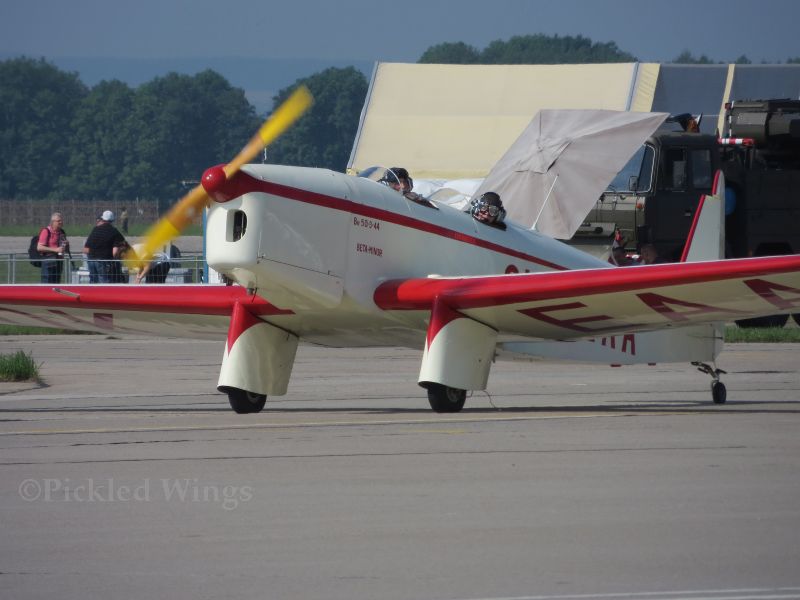
Fortunately, the original factory drawings endured, and in the early 2000s the Military Historic Institute of the Czech Republic (VHU) undertook several years of careful work to construct a new Be-50 faithful to those plans. Completed in 2013, it was first displayed statically before making its maiden flight in 2015. Entered onto the Czech civil register, it flew actively from 2015 to 2018 and appeared at shows across the country.
Sadly, the aircraft and its pilot were lost in an accident in 2018.
This aircraft incorporated only a few concessions to modern aviation regulations and was given construction number 44, continuing the sequence begun by the original 43 Be-50s built by Beneš-Mráz decades earlier. In many quarters it was regarded not as a replica but as a genuine Be-50.
When not flying, it was usually displayed at the Methodius Vlach Aviation Museum in Mladá Boleslav, northeast of Prague.
As the original Be-50 plans still exist, it remains possible that another example may one day be built, allowing its elegant lines to grace the skies once more.
This link will take you to a dedicated Be-50 page on the VHÚ website. It’s all in Czech, but responds well to online translators.
 Pickled Wings