
The Last of the Old Guard
Though the interwar period is generally remembered as the time when the biplane gave way to the monoplane, the transition was gradual in many contexts.
Biplanes were not without merit, and several military air arms around the world kept them as their primary fighters well into the interwar era. Compared to monoplane designs of the time, biplane fighters often offered superior climbing performance, manoeuvrability, and overall responsiveness.
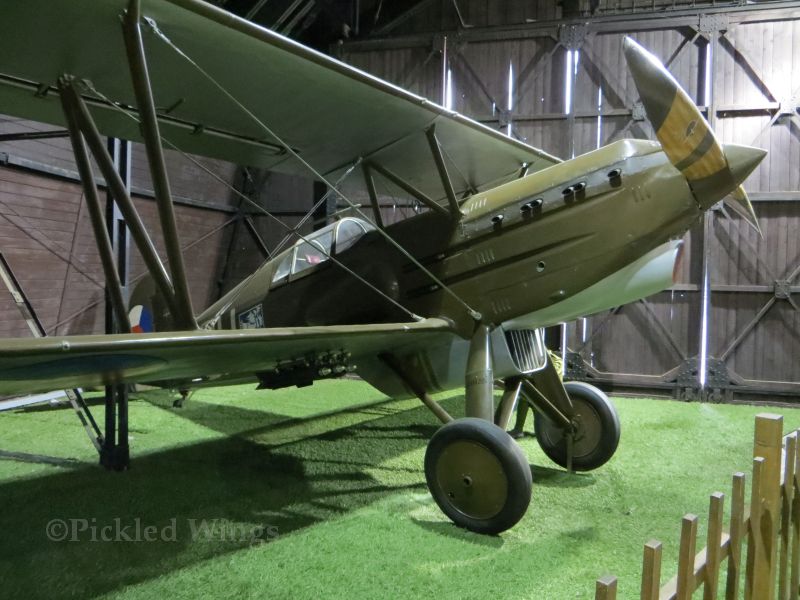
The Avia B.534 became symbolic of Czechoslovak air power and, along with the Fiat CR.42 Falco from Italy and the Polikarpov I-153 Chaika from the Soviet Union, was widely regarded as the apex of biplane fighter development. All three types remained active in the fighter role during the early stages of the Second World War; in fact, the last confirmed aerial combat victory for a biplane fighter was scored in an Avia B.534.
The Man Behind the Machine
The designer of the B.534, František Novotný, became Avia’s chief engineer in 1930 after the company’s founders departed following its merger with Škoda.
A First World War veteran, Novotný had nurtured a deep interest in aviation from a young age. He spent a brief period in Great Britain working for H.G. Hawker before returning to Czechoslovakia to complete his engineering education. The knowledge he gained at Hawker served Avia well, as he applied it directly to the aircraft he designed and oversaw.
The B.534 had its origins in the B.34, the first aircraft Novotný designed after joining Avia. In 1932, the company obtained a modern French-built Hispano-Suiza 12-cylinder in-line engine and installed it in the second B.34 prototype. With significant modification and streamlining, this became the prototype B.534, which first flew in May 1933.
The B.534 entered service with the Czechoslovak military in late 1935. It was a clean design that combined metal, fabric, and wood construction. Although the initial version suffered some structural problems, it was a fast and responsive machine that proved popular with pilots. Through four successive versions, it matured into a competent and dependable fighter for its time.
By the late 1930s, the B.534 had demonstrated itself to be a close match for Germany’s Messerschmitt Bf 109B in terms of speed. At an international competition in Switzerland in 1937, the Avia was clocked at only 11 kilometres per hour slower than the German monoplane.
Into the Fray
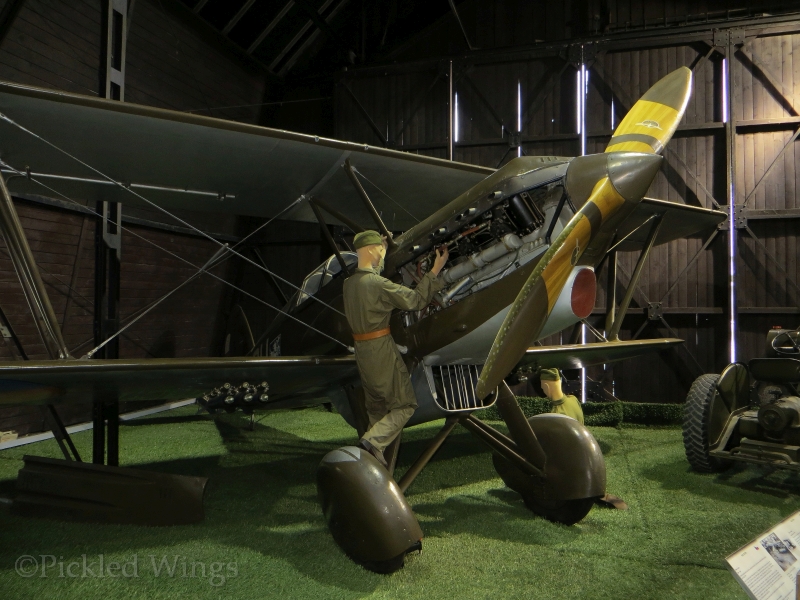
The Munich Agreement of 1938 placed Czechoslovakia under Hitler’s bootheel and, as a result, its military assets were annexed by Germany. In 1939, when Germany forcibly split the country into the Bohemian and Moravian Protectorate in the west and the Slovak Republic in the east, the B.534 saw combat for the first time.
Almost as soon as the Slovak Republic had been established under a Nazi-friendly, collaborationist government, Hungarian forces staged an attack on Slovak territory. In a series of border skirmishes, Slovak Avias secured no aerial victories and several were lost to anti-aircraft fire and Hungarian fighters.
It was during this combat that the B.534’s weaknesses became clear: it was lightly armoured, lacked self-sealing fuel tanks, and was under-gunned for the demands of modern warfare. These shortcomings did not prevent the aircraft from further combat use, but they ensured it would remain a bit player in the Second World War.
Through the first year of the conflict, Slovakia also deployed the type in limited actions against Poland and the Soviet Union.
The final combat for Slovak Avias came in 1944 during the Slovak National Uprising, a resistance movement aimed at toppling the collaborationist government and turning against Germany. By then, the B.534 was thoroughly outclassed as a fighter. Nevertheless, in early September that year, a resistance-flown B.534 shot down a Hungarian Junkers Ju 52 transport bound for Poland. While this was the last confirmed aerial victory for a biplane fighter, it would have been preferable had the transport been forced down intact, as the resistance was desperate for any usable aircraft. Ultimately, the uprising was suppressed.
Aside from Slovakia, the only other nation to field the B.534 as a fighter during the war was Bulgaria. The Bulgarians purchased several from Germany and notably used some against American bombers raiding the Ploiești oilfields in Romania in August 1943. Though the Avias scored hits, their guns lacked the power to penetrate American aircraft armour.
The German Luftwaffe used many of the Avias confiscated from Czechoslovakia as trainers and glider tugs.
Other minor users included Croatia, Greece, Hungary, Romania, and the Soviet Union.
The B.534 Family
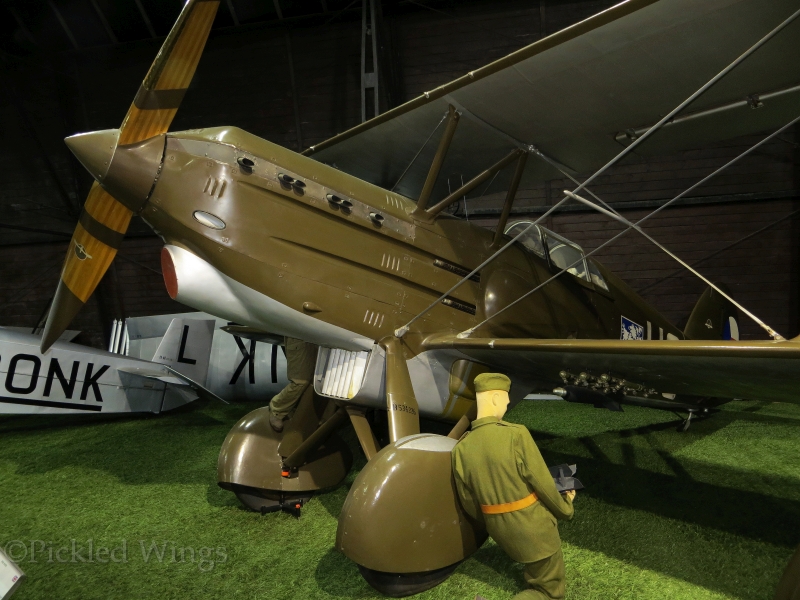
The basic B.534 evolved through four sub-types, referred to as “series.” Most differences between them were subtle, involving internal structural strengthening, rearranged gun placements, and general streamlining.
The ultimate version was the Series IV. Its most visible change was a fully enclosed cockpit, complete with a heater for pilot comfort.
Most B.534s carried wooden propellers, though many later Series IVs were fitted with more modern metal ones.
The aircraft came standard with aerodynamic fairings over the wheels, but in practice these were often removed as they clogged with mud on wet grass airstrips. The Avia could also be fitted with skis for snow operations.
The specialized Bk.534 mounted a 20-mm cannon firing through the propeller hub via a hollow shaft. To offset the weight of the cannon, two of the standard four machine guns were removed. Adapting the cannon, however, proved problematic, and the Bk.534 never entered service.
An unusual chapter in the Bk.534 story came when the German navy modified three examples to test their suitability for aircraft carrier operations. They proved completely unsuitable, though this was of little consequence as the German carrier Graf Zeppelin was never completed.
Lastly, the B.634 of 1936 represented an attempt to further refine the B.534’s aerodynamics and performance. While it achieved some improvements, it suffered significant problems, and only a single example was built.
What Remains and Learning More
The B.534 might be considered a ghost in the truest sense, as none of the roughly 560 built have survived. All that remains are photographs and memories.
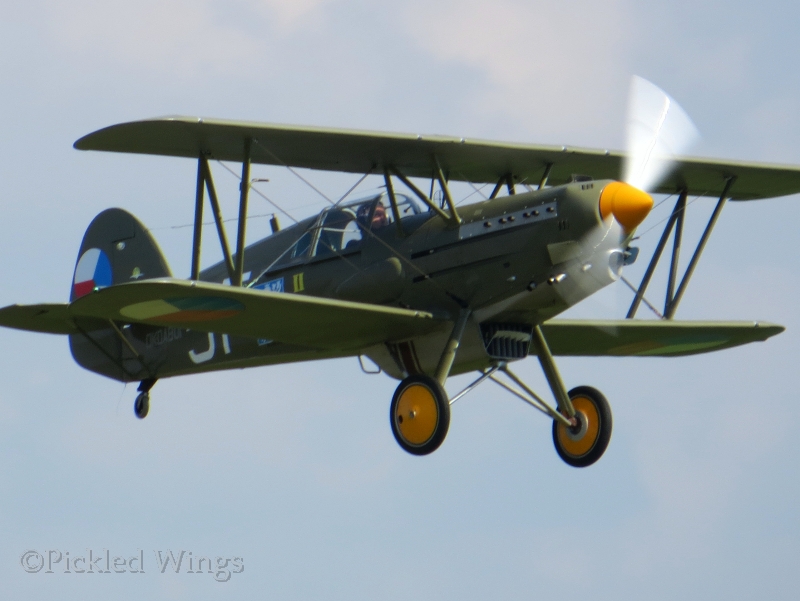
Two full-scale replicas, built from original plans, are on display at museums in Prague, Czech Republic, and Košice, Slovakia.
Since 2013, a 30%-scale replica of a Series IV aircraft has been on the Czech civil register. Though smaller than the original, great care has been taken to ensure it faithfully reflects the shape and proportions of the real aircraft.
To learn more, follow these links to fuller information about the B.534 and about František Novotný. Both articles are in Czech but respond reasonably well to online translation tools.
 Pickled Wings